Hot Upstairs, Cold Downstairs: Uneven Rooms
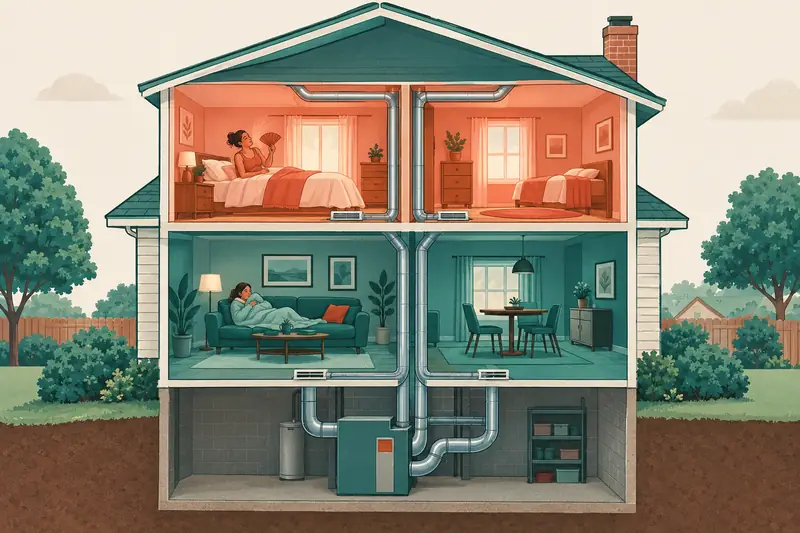
Hot upstairs, cold downstairs? Warm air rises, but leaky ducts, blocked registers or returns, a dirty filter and attic heat usually widen the gap; start with the filter and the grilles.
Checked against makers' and agencies' documents by Hum Drip Hiss · how pages are made · Updated
Vitals
- About 20 to 30 percent of the air moving through a typical duct system is lost to leaks, holes and poor connections, per ENERGY STAR.
- ENERGY STAR lists "rooms that are difficult to heat and cool" and ducts in an attic, crawlspace or garage as signs of poorly performing ducts.
- A 2003 Lawrence Berkeley National Laboratory study found closing registers raised energy use in the California houses it modeled.
- The same study warns that closing more than 60% of registers restricts airflow enough to raise safety concerns.
- Look at the filter every month; a 1-inch filter should never go past 3 months, per ENERGY STAR.
- Duct sealing and airflow balancing are technician work; DOE says all duct sealing should be tested by a qualified professional.
Why is it hot upstairs and cold downstairs?
Some of the gap is physics: warm air rises, so a second floor tends to run warmer than the first even when the system works. Trane adds that a sun-heated roof warms the attic, and that heat settles onto the top floor when the attic or roof is poorly insulated. Lennox names the same trio: rising heat, attic gains and duct imbalances.
The most common causes, roughly in the order worth checking:
- Blocked supply registers or return grilles. Furniture, rugs or drapes over a grille starve that room of air.
- A dirty filter. A clogged filter cuts airflow to every room, and the farthest rooms (often upstairs) feel it first.
- Leaky or crushed ducts, especially ducts running through a hot attic or cold crawlspace.
- Weak return air upstairs. Lennox notes that return air pathways upstairs are critical for airflow.
- One thermostat for two floors, set where the downstairs temperature decides when the whole house heats or cools.
- A system sized or designed poorly for the house, which a technician has to judge.
Do leaky ducts cause uneven rooms?
Yes, they can be a big part of it. ENERGY STAR says about 20 to 30 percent of the air moving through a typical duct system is lost to leaks, holes and poorly connected ducts, leaving the house hard to keep comfortable "no matter how the thermostat is set." Its warning signs include rooms that are difficult to heat and cool, stuffy rooms, and tangled or kinked flexible ducts.
DOE's Energy Saver booklet (2022 PDF, p.17) says discomfort can often be addressed by fixing blocked registers, stuck dampers, or disconnected or damaged ducts. It also says to hire a qualified professional for duct changes, and that all duct sealing should be tested to ensure combustion safety and proper airflow. So look, but leave the ductwork itself to a technician.
Should you close registers in unused rooms?
Usually not. Closing registers can unbalance airflow, and a Lawrence Berkeley National Laboratory study (LBNL-54005, 2003) found that register closing increased energy use across the California houses it modeled with ducts outside conditioned space. That is one study of one housing type, so it does not prove closed vents always cost more, but it found no saving to chase.
The same study warns that closing more than 60% of registers restricts airflow so much that furnaces may run on the high-limit switch and cooling coils may freeze. If a room is too warm or too cold, a technician can measure and balance airflow instead. Keep registers open and see frozen AC coil if you already find ice on the indoor coil or refrigerant line.
What can you check yourself when it's hot upstairs?
You can safely check the filter, the grilles and the thermostat in about 10 minutes, the same order as the site's 10-minute safe checks.
- Filter. Pull it out once a month and hold it to the light. Swap it once it looks gray or the filter maker's interval is up, and no later than 3 months for a 1-inch filter (ENERGY STAR maintenance checklist).
- Supply registers. Open every one. Carrier says to open all heat vents and keep return-air grilles clear of furniture, rugs and other objects.
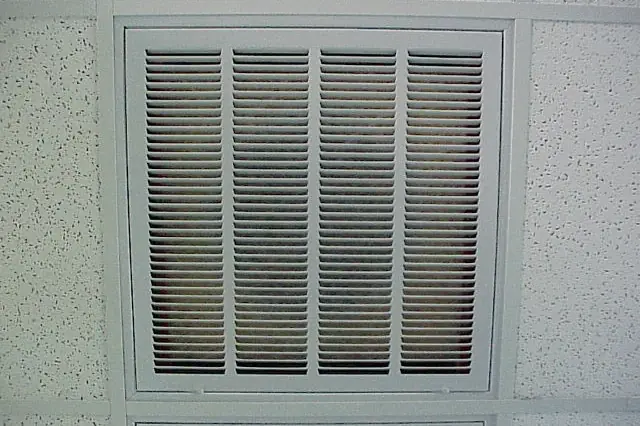
- Return grilles. Vacuum the slats and move anything blocking them, upstairs especially.
- Thermostat. Confirm the mode and setpoint, and note whether the thermostat sits in sun or near a heat source on the main floor.
- Ducts you can see. In a basement or attic you can reach safely, look for a flexible duct that has fallen, kinked or come loose. Don't cut, tape or reroute anything; write down what you saw.
- Window coverings. DOE suggests keeping coverings closed during summer days to block the sun's heat, which helps sunny upstairs rooms.
When uneven rooms mean stop and call
- A burning, plastic or electrical smell from a register: turn the system off at the thermostat and the furnace switch or breaker, then call. Smoke or flames: get everyone out and call 911.
- The HVAC breaker trips again after you reset it once. Leave it off.
- Ice on the indoor coil or refrigerant line. Switch cooling off and let it thaw before calling.
- Water pooling near the furnace or air handler, especially near wiring.
- The furnace keeps shutting off after only a few minutes (short cycling).
- If you're unsure, stop and call a licensed HVAC technician.
Which adjustments can a technician make for a hot upstairs and cold downstairs?
A technician can measure what each room actually receives and change it. Lennox describes air balancing as airflow testing with instruments that measure duct pressure and compare airflow room by room, then adjusting dampers and registers and retesting. Ask whether the house has balancing dampers and how they are set.
Other options a technician may raise are sealing and insulating ducts, adding a return upstairs, or zoning, which gives each floor its own thermostat. ENERGY STAR suggests asking the contractor to inspect the duct system, perform a leakage test and make the needed repairs.
When is it the house, not the HVAC?
Sometimes the building is the main cause. DOE's 2022 Energy Saver booklet says air leaks are among the greatest sources of energy loss in a home, and that sealing uncontrolled air leaks can save 10% to 20% on heating and cooling bills. Thin attic insulation, leaky attic hatches and big west-facing windows can all heat an upstairs faster than any duct can cool it.
ENERGY STAR's replace page lists "Some rooms in your home are too hot or too cold" as one prompt to have a contractor evaluate the system, alongside age and rising bills. That is a reason to ask questions, not proof the equipment must go. See the comfort and bills overview for how rooms, bills and humidity connect, and why an electric bill jumps if the gap arrived with higher bills.
What to tell the technician
The pattern
Which rooms, which floor, how many degrees apart, and whether it happens in heating, cooling or both.
When it started
Always, since a remodel or new equipment, or recently. A sudden change points at something that moved or failed.
What you checked
Filter date, registers and returns opened, any fallen or kinked duct you saw, and where the thermostat sits.
Anything odd
Ice, water, smells, noises or a breaker that tripped. Mention these first.
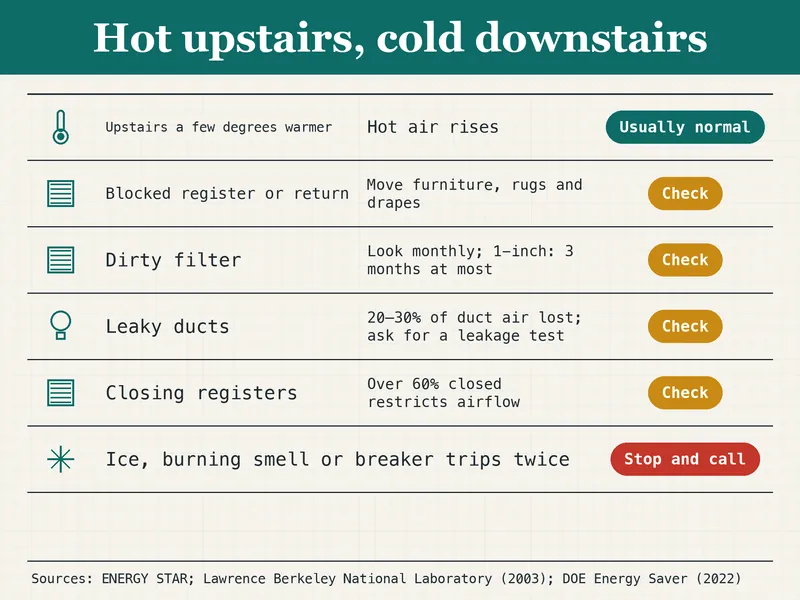
Numbers on the chart
- 20–30%of air moving through a typical duct system lost to leaksENERGY STAR
- 60%share of closed registers above which airflow is severely restrictedLawrence Berkeley National Laboratory, 2003
- 10–20%heating and cooling bill saving from sealing uncontrolled air leaksDOE Energy Saver, 2022
- 3 monthslongest gap between 1-inch filter changesENERGY STAR
| What you notice | Usual reason | What you can do | Call a technician when |
|---|---|---|---|
| Upstairs a few degrees warmer in summer | Rising heat, attic heat | Close sunny-side blinds by day; check the filter | Gap keeps growing or the system runs nonstop |
| One room weak or stuffy | Blocked register or return | Open the register; clear and vacuum the return | Airflow stays weak with grilles clear |
| Several far rooms weak | Leaky, loose or crushed ducts | Look at reachable ducts; note what you see | You find a loose or fallen duct |
| Rooms cold, furnace stops after minutes | Dirty filter or high-limit trips | Replace the filter | Cycling continues with a clean filter |
| Ice on the indoor coil | Low airflow, many closed registers | Cooling off; let it thaw fully | Ice returns after a full thaw |
Case notes
This page is based on ENERGY STAR's duct sealing, maintenance checklist, quality installation and replacement pages; DOE's Energy Saver booklet (August 2022); Lawrence Berkeley National Laboratory report LBNL-54005 on register closing (2003); and Trane, Lennox and Carrier homeowner pages, all read in October 2026. It leaves out homeowner damper or duct-balancing steps, because no primary source gives a safe procedure, and any repair prices.
Asked at intake
Is a few degrees' difference between floors normal?
Some difference is expected because warm air rises, as Trane and Lennox both note. No source gives a universal acceptable gap, so judge by comfort and change: a gap that suddenly widens points at a blocked grille, a dirty filter or a duct problem.
Does running the fan on ON even out the floors?
It keeps air moving between floors, but in cooling season it can carry moisture from a wet coil back into the house, and DOE suggests AUTO unless a professional set the system up to run continuously. Try it briefly and judge comfort, then return to AUTO.
Can a room's register be partly closed to push air upstairs?
The Lawrence Berkeley study found closing registers did not save energy in the houses it modeled, and closing many restricts airflow. Leave adjustments to a technician who can measure airflow before and after.
Why is the basement cold when the furnace runs fine?
Basements lose heat to the ground and often have few supply registers. If the rooms above are comfortable and the furnace cycles normally, it is usually a design limit rather than a fault.
Should I seal ducts with duct tape?
ENERGY STAR says to use mastic sealant or metal tape and never duct tape, which does not last. DOE adds that duct sealing should be tested by a qualified professional for combustion safety and airflow.
Does a second thermostat fix uneven floors?
Only if it controls something, such as a zoned system with dampers or a second unit. A second thermostat alone just reports a second temperature.
Could an old system cause new hot and cold rooms?
ENERGY STAR lists rooms that are too hot or too cold among the prompts to have a contractor evaluate the system. Age alone is not a diagnosis; ask what the technician measured.
More comfort problems