Furnace Clicking Noise but No Heat
A furnace clicking noise with no heat usually means the ignition sequence is starting and failing, often at the igniter, flame sensor or pressure switch; check the thermostat, power and filter, then call.
Checked against makers' and agencies' documents by Hum Drip Hiss · how pages are made · Updated
Vitals
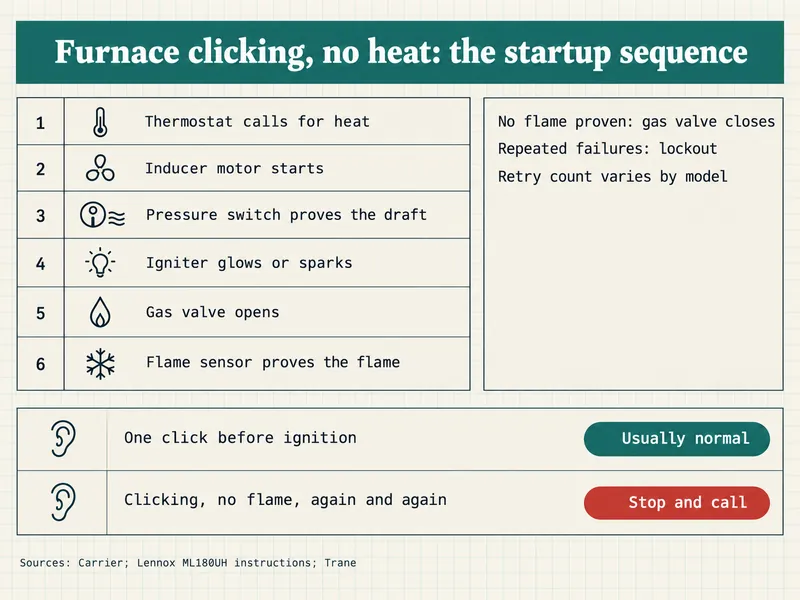
- One click before the burners light is normal, per Trane; clicking that repeats with no flame is not.
- Carrier lists the startup order as inducer motor, then igniter, then gas valve, and says the control closes the gas valve if no flame signal is detected (Carrier).
- Carrier's igniter page lists "clicking sounds without ignition" as a sign of a bad igniter and advises leaving the part to a professional.
- How many tries a furnace makes before it locks out "varies by model and control system," Carrier says; there is no universal count.
- Your checks: thermostat on Heat, furnace switch on, filter, panel seated, other gas appliances working.
Clicking with no heat usually means the furnace is trying to light, failing to confirm a flame, and shutting the gas off.
Why is the furnace clicking with no heat?
The furnace is cycling through its ignition steps without getting a proven flame. Each attempt can bring clicks from the controls and, on furnaces with a spark igniter, the snap of the spark itself. Carrier's igniter page names "clicking sounds without ignition" as a sign of a bad igniter, and says a furnace "repeatedly attempting to start without success" often points there.
Other causes sit on either side of the igniter. A dirty or failing flame sensor lets the burners light and then shuts them off within seconds. A pressure switch that never closes stops the sequence before the igniter starts.
What is the furnace trying to do when it clicks?
It is running a fixed safety sequence. Carrier gives the normal order as "inducer motor, then ignitor, then gas valve." Carrier's parts page says the inducer fan clears remaining gases from the heat exchanger before the burners ignite.
Between the inducer and the igniter, a pressure switch confirms the draft. Rheem's M2 user manual says that with a restricted combustion air supply "the pressure switch will open, turning off the gas supply to the burners." Once the gas lights, the flame sensor has to see it: Carrier says "if no signal is detected, the control board closes the gas valve and the furnace shuts off." After several failures the control locks out.
Which furnace clicking noises are normal?
A click before the burners light is normal. Trane lists "a clicking noise before ignition" among ordinary furnace sounds. What is not normal is clicking that repeats with no flame and no warm air.
Trane's noises page blames indoor clicking on a faulty control board, a loose connection, a safety switch or the thermostat, and suggests noting whether it happens at startup, at shutdown or all the time.
| What you hear | Likely meaning | Safe check | Stop and call if |
|---|---|---|---|
| One click, then burners light and heat follows | Normal relay or ignition click | None needed | It changes to repeated clicking |
| Inducer hums, then clicking, no flame | Igniter, gas supply or gas valve | Thermostat, switch, other gas appliances | It repeats after one power cycle |
| Burners light, then shut off within seconds | Flame not proven, often the flame sensor | Filter, note the blink count | Every time; sensor work is technician work |
| Inducer runs, no igniter glow or tick | Pressure switch or draft problem | Filter; note the blink code | The blink code points to the pressure switch |
| Clicking with a gas smell | Possible leak | None: leave first | Every time |
What can you check before calling?
You can check the settings, power, airflow and gas supply from outside the cabinet. Carrier's checklist starts with the thermostat on Heat, the furnace power switch on, and the filter. The 10-minute safe checks list walks through each one.
- Thermostat. Mode on Heat, setpoint a few degrees above room temperature, fresh batteries if it uses them. A blank screen has its own checklist.
- Power. The furnace switch, which looks like a light switch, should be on, and the furnace breaker should not be tripped. A tripped breaker gets one reset; a second trip means it stays off until a technician has looked.
- Front panel. On many furnaces a loose panel opens a safety switch, and Trane says that switch shuts off power and gas. Press a loose panel back into place.
- Filter. Check it each month and replace it when it is dirty, per its maker, with 3 months the upper limit for a 1-inch filter.
- Gas supply. Carrier says to check whether other gas appliances, such as a range or water heater, are working; if none are, contact the gas utility.
- The blink code. Read the light through the sight window and match the count to the label on your furnace's door. The same count means different things on different furnaces; see the blinking light page.
Keep the burner door closed, and don't touch the igniter or flame sensor or press any reset button inside the cabinet. Carrier says flame sensors should be maintained by "a trained HVAC professional," and that bypassing one "should never be attempted."
Stop and call if
- The clicking repeats with no flame after one power cycle
- The burners light and go out within seconds, over and over
- The furnace light shows a lockout or ignition-failure code on its label
- A second breaker trip after the one reset
- Clicking plus a gas smell: leave the house with everyone right away. Light nothing, leave switches, phones and the meter alone, and make the call to 911 or the gas company's emergency number (often both) only from well away. Return only when they clear it
- If you're unsure, stop and call a licensed HVAC technician.
What do igniters and flame sensors do?
The igniter lights the gas, and the flame sensor proves it lit. Carrier says most modern furnaces use an electronic hot surface igniter in place of a standing pilot, and "if the igniter fails, the furnace will not be able to produce heat."
The flame sensor is a thin metal rod in the burner assembly. If it can't detect a flame, Carrier says it "automatically shuts off the gas supply to prevent dangerous unburned gas from accumulating in your home." Older standing-pilot furnaces do the same job with a thermocouple, which Carrier says is a different part and "not interchangeable" with a flame sensor. All of these sit beside the burners and gas valve, which is why they are technician parts.
The listings below show what these parts look like and how they are specified. They are a technician's parts, matched to the furnace model, not something to buy and fit yourself.
When should you stop resetting it?
After one try. Write down the blink code first, since cycling power can clear it. Then turn the furnace off at its switch and back on once; if the clicking returns, leave it off and call.
Lockouts are a safety feature, not a glitch to override. Carrier says the number of ignition attempts before lockout "varies by model and control system." Rheem's standard furnaces use a 1-hour soft lockout, and Carrier's 58MVP service literature says its ignition lockout auto-resets after 3 hours. If the furnace also cycles on and off quickly once it does light, see short cycling.
Tell the technician
The blink code
The count and color, written down before any reset, and the furnace model from the label.
The pattern
How many clicks, whether the inducer runs, whether you saw a glow or flame through the window.
What still works
Other gas appliances, the thermostat, the blower.
What you checked
Thermostat mode, switch, breaker, filter, panel, and the one power cycle you tried.
Readings
- 1 clickA click before ignition is a normal furnace soundTrane
- 7 flashes"Lockout, burners fail to light" on the Lennox ML180UH controlLennox ML180UH installation instructions
- 1 hourSoft lockout on Rheem standard single-stage gas furnacesRheem
- 3 hoursAuto-reset time for an ignition lockout on the Carrier 58MVPCarrier 58MVP service literature
Case notes
Sources: Carrier's flame sensor, igniter, furnace parts, cold-air and troubleshooting pages, Carrier's 58MVP service literature, Trane's furnace noise, HVAC noise and blinking-light pages, Lennox ML180UH installation instructions, Rheem's blink-code page and M2 user manual, all read in October 2026. Left out: flame sensor cleaning, igniter testing, pilot relighting and any reset inside the cabinet, because the makers reserve them for technicians; also repair costs.
Asked at intake
Why does my furnace click three times and then stop?
Clicks then silence often means ignition tries failed and the control stopped. The number of tries before lockout depends on the model, so check the blink count against the label rather than counting clicks.
Can a dirty filter make a furnace click without heating?
Per Carrier, a filter packed with dust lets the heat exchanger run hot until a limit switch cuts the burners while the fan keeps going. That shows as cold air more than clicking, but it is the easiest thing to rule out.
Flames appear, then vanish seconds later. Is that the igniter?
Often not. Carrier says a dirty or faulty flame sensor is one of the most common reasons a furnace starts and then shuts off after a few seconds. The sensor sits in the burner assembly: a technician call.
Can restricted combustion air stop the sequence?
Yes. Rheem's M2 manual says a restricted combustion air supply opens the pressure switch and turns off the gas to the burners. On many furnaces that shows as an inducer that runs with no ignition and a pressure-switch code on the label.
Will the furnace try again on its own after a lockout?
Some do. Rheem's standard furnaces use a 1-hour soft lockout, and Carrier's 58MVP clears an ignition lockout after 3 hours. If heat returns and the clicking comes back, the fault is still there.
Is a clicking furnace a carbon monoxide risk?
Clicking alone means the gas is not lighting, and the control closes the gas valve when it sees no flame. CPSC still wants a CO alarm on each floor and outside sleeping areas; if one sounds, get everyone outside and call 911 from there.
More sounds and next steps
Back to the six symptom folders