AC Leaking Water Inside
AC leaking water inside? Most often the condensate drain line is clogged, so the pan under the indoor coil overflows; a stopped condensate pump or a cracked pan come next.
Checked against makers' and agencies' documents by Hum Drip Hiss · how pages are made · Updated
Vitals
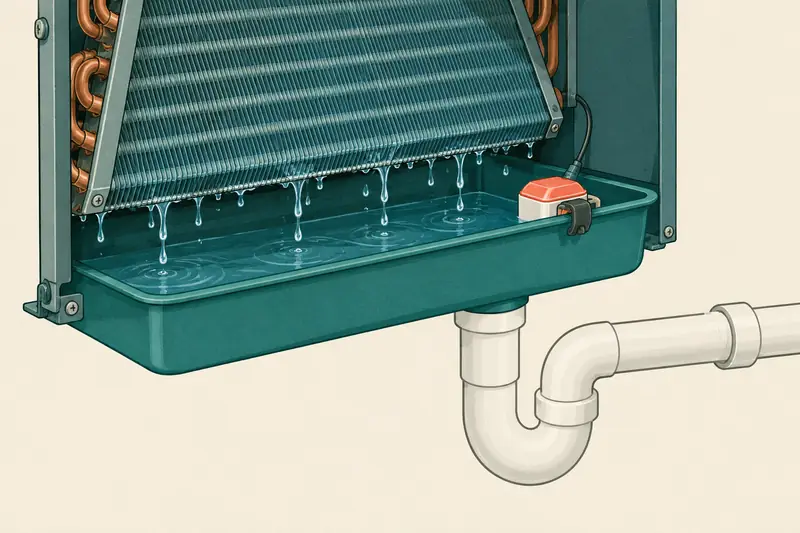
- An indoor cooling coil pulls water out of the air all summer; Trane says it drains into a pan and then a line, and a clogged pan can overflow.
- Carrier's drain-line steps start with power off, then about 1 cup of distilled vinegar poured into the indoor access point.
- Chlorine cleaners are left out of this site's drain steps; distilled vinegar or the maker's approved PVC-safe cleaner is the limit, and neither clears every clog.
- EPA advises drying wet materials within 24 to 48 hours to head off mold.
- A float or overflow switch shuts the system down when the pan fills, so a dead AC in July and a wet pan often go together.
- ENERGY STAR lists the condensate drain on its maintenance checklist because a plugged one can cause water damage.
Why is the AC leaking water inside?
The usual answer is a blocked condensate drain line: water has nowhere to go, so the pan under the coil fills and spills. In a typical split system, the indoor coil sits on top of the furnace or inside an air handler, and the water you see on the floor started as humidity in your house air. Trane's air handler page lists a clogged, cracked or rusted drain pan and a faulty float switch as the other common sources.
Likely causes, most common first:
- Algae, sludge or debris plugging the drain line or its trap.
- A condensate pump that has stopped, lost its power cord or has a kinked discharge tube.
- A cracked or rusted drain pan under the coil.
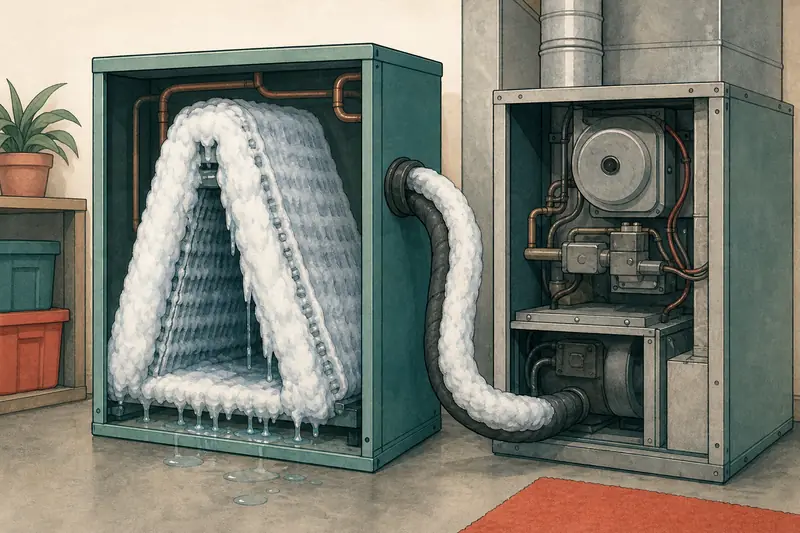
- A frozen coil that is now melting faster than the drain can carry the water away (see frozen AC coil and ice on the lines).
- Something else entirely: a water heater, washer or utility sink in the same room.
If the drip is from a furnace in winter, the cause is often different; the furnace leaking water page covers condensing furnaces and humidifiers.
How does the condensate drain work?
Warm, damp house air crosses the cold coil, moisture condenses on the fins, and gravity carries it from a pan into a drain line. That line usually has a U-shaped trap and runs to a floor drain, a laundry standpipe, the outdoors, or a small condensate pump. Some installations also have a second pan or an overflow line as a backup.
ENERGY STAR's checklist calls out this drain on central air conditioners, furnaces and heat pumps in cooling mode, and notes that a plugged drain can affect indoor humidity as well as cause water damage. A slow drain also keeps the pan wet, which is one reason a musty smell can follow (see dirty sock syndrome).
How do you unclog an AC drain line safely?
Turn the power off first, then flush from the access point with distilled vinegar or the maker's approved cleaner. Carrier and Trane both describe roughly a cup of distilled vinegar; Lennox describes diluted vinegar or an approved cleaner made for PVC, left for 30 minutes or longer and then flushed with water.
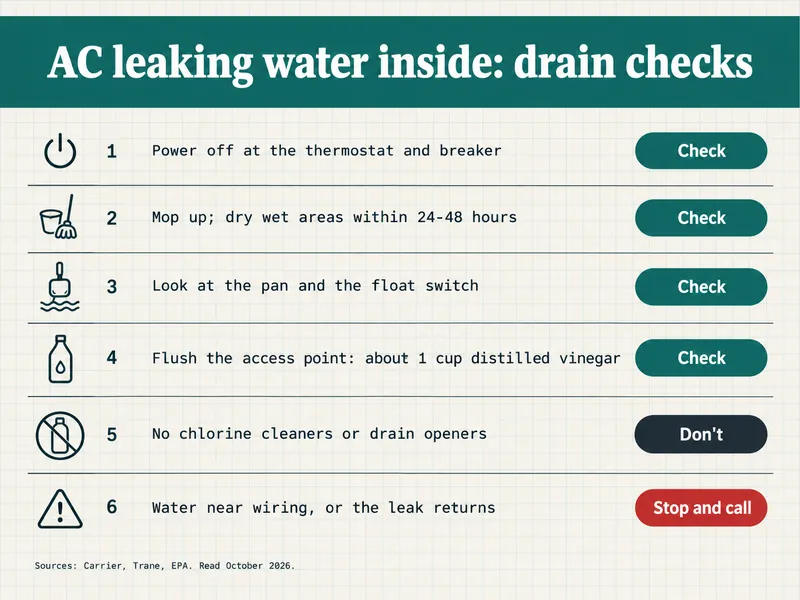
Safe steps for an AC leaking water inside:
- Set the thermostat to OFF, then switch off the HVAC breaker or the furnace or air handler switch.
- Mop or wet-vac the water and set wet items out to dry.
- Find the access point: usually a capped T or vent on the drain line near the indoor unit. Do not cut pipe or open the equipment cabinet.
- Pour about 1 cup of distilled vinegar (or the maker's approved cleaner) into the access point and wait about 30 minutes.
- Follow with plain water and watch the outlet to see whether it runs freely.
- Carrier also describes using a wet/dry vacuum at the outdoor end of the line to pull a clog out.
- Restore power and watch the pan through one cooling cycle.
Skip chlorine cleaners and drain openers. Carrier notes that vinegar may not clear every blockage, because many clogs are debris rather than organic growth. If the line still won't drain after one flush, stop there; the full order of homeowner checks is on safe checks before you call.
What does the float or overflow switch do?
It is a small safety switch that cuts the system when water rises in the pan or line, so the leak stops before it reaches the ceiling or floor. Trane describes a drain pan condensate safety switch that will shut down the indoor unit as the water level rises, and notes that some states do not require one when the condensate drains outside.
That switch explains a common pairing: no cooling, sometimes a blank thermostat, and a full pan. Don't bypass, tape or remove the switch to get cooling back. Clear the water and the drain, and the switch normally resets on its own once the level drops; if it doesn't, a technician should check it.
What if a condensate pump is involved?
A condensate pump is a small tank with a float and a motor that lifts water to a drain when gravity can't. Daikin's air handler installation instructions say a condensate pump should have provisions for shutting off the control voltage should a blocked drain occur, which is why a full pump can also stop cooling.
Homeowner checks stop at the outside of the pump: confirm it is plugged in, the outlet has power, the discharge tube isn't kinked or frozen outdoors, and the tank isn't packed with sludge you can see through the lid. Pump wiring, the safety switch leads and replacement are a technician's work.
When does the leak need a technician?
Call when the drain won't clear with one flush, when water touches anything electrical, or when the pan itself is cracked. Trane's air handler page says to shut the system off at the thermostat or breaker, mop up, and have a technician inspect the coil, pan and line. Ice on the coil is a separate problem with its own causes, and the stop-and-call list covers every sign that ends homeowner work.
Stop and call if
- Water is reaching wiring, a control board, an outlet or the furnace cabinet.
- The ceiling below an attic air handler is stained, sagging or dripping.
- The condensate pump hums but doesn't empty, or its cord or tubing looks damaged.
- The leak comes back within days of a flush.
- There is ice on the coil or the copper lines that doesn't clear.
- If you're unsure, stop and call a licensed HVAC technician.
Jot down a few details before the visit; they shorten the diagnosis.
Notes to hand the technician
First sighting
The day you first saw water and whether it appears only while cooling runs.
Where the water is
Under the coil, at the pump, along the line, or from the ceiling.
What you already tried
The vinegar flush, when you did it, and whether the outlet ran afterward.
Whether cooling stopped
A system that quit with a full pan points to the float switch.
What the sources say
- 1 cupdistilled vinegar for a drain-line flushCarrier
- 30 minlet vinegar or a PVC-safe cleaner sit before flushingLennox
- 24–48 hrswindow to dry water-damaged materialsEPA
- 1–3 monthsTrane's filter-change habit for air handlersTrane
| What you see | Probable cause | What you can check | Call when |
|---|---|---|---|
| Puddle under the coil in summer | Clogged drain line or trap | Power off, flush the access point with vinegar | It won't drain after one flush |
| Pan full, system off | Float switch tripped | Clear the water and the line | Cooling won't restart once dry |
| Water at a small tank by the unit | Condensate pump stopped | Plug, outlet, tubing | Pump hums but won't empty |
| Rust or a crack in the pan | Pan worn through | Note where it drips | Always: pans are a technician's part |
| Water plus ice on the lines | Frozen coil melting | Cooling off, let it thaw | Ice returns after the thaw |
The condensate pump card above is a technician's part: it shows what the part looks like and how it is specified, so you can follow what a technician says about it.
Case notes
This page draws on Carrier's and Lennox's drain-line pages, Trane's air handler and AC troubleshooting pages, Daikin's air handler installation instructions, ENERGY STAR's maintenance checklist and EPA's mold and moisture page, each read in October 2026. Not covered here: chlorine cleaners (one maker page mentions them; the others and this site don't), cutting into drain pipe, pump wiring, and any repair prices.
Asked at intake
Is it safe to run the AC while it's dripping inside?
It is better not to. Shut cooling off at the thermostat, clear the water, and flush the line first, because a full pan can reach wiring and soak ceilings or floors.
How often should an AC drain line be flushed?
Makers don't set one interval for every home. Trane suggests asking your technician to show you the distilled-vinegar pour if the line keeps clogging, and ENERGY STAR puts the drain on its routine checklist.
Why does my AC only leak on very humid days?
More moisture in the air means more water off the coil. A drain that is partly blocked can keep up on dry days and fall behind when the coil is producing much more.
Can a dirty filter make an AC leak water?
Yes, indirectly. A clogged filter can starve the coil of airflow until it freezes, and the ice then melts faster than the drain can carry it.
Where is the drain line access point?
Usually a short vertical pipe with a cap or a T fitting near where the line leaves the indoor unit. If you can't find one without opening a panel, leave the flush to a technician.
Is a little water in the pan normal?
Yes, while cooling runs the pan holds a thin layer that keeps draining away. Standing water that doesn't drop after the system stops points to a slow or blocked line.
Will an overflow switch stop all water damage?
It helps, but it only works if it is installed, positioned correctly and working. Some homes don't have one at all, which Trane notes is allowed in some states.
Next on water and ice
Back to the Hum Drip Hiss front desk