AC Unit Buzzing or Humming but Not Running
AC unit buzzing or humming while the fan sits still? Carrier says the capacitor has likely failed; turn the system off at the thermostat and breaker, because the fix is live-voltage technician work.
Checked against makers' and agencies' documents by Hum Drip Hiss · how pages are made · Updated
Vitals
- "If your AC fan is not spinning but making a humming noise, the capacitor has likely failed," says Carrier, which adds that capacitors hold a high-voltage charge even when power is off.
- Trane lists the capacitor, the contactor and the fan motor as outdoor causes of a loud hum, and says to call for repair (Trane).
- Running the AC without a working condenser fan can overheat the compressor, so Carrier says to turn the system off rather than let it run.
- Bryant's own reset steps wait 30 minutes after the breaker is off "for the internal charge to dissipate" (Bryant).
- A hum with the outdoor fan stopped during heat pump defrost is normal; defrost usually lasts a few minutes, up to about 15.
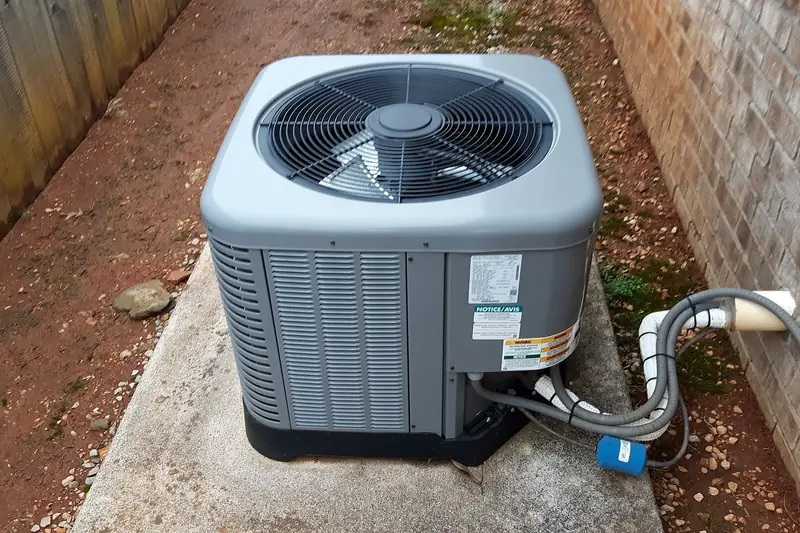
A healthy outdoor unit hums. One that hums while its fan stands still has a motor that is powered but not turning, and the likely causes sit inside the electrical box.
Why is the AC unit buzzing?
Most often a motor is getting power but can't start. Carrier lists a failed run capacitor, a burnt-out fan motor, a tripped breaker and a clogged filter among the reasons an AC fan won't spin, and describes "a buzzing sound coming from the motor" as a symptom of motor trouble. Trane adds the contactor, an electrical switch inside the outdoor unit, to the list.
Lennox explains why the capacitor comes first: it "stores energy to start and stabilize compressor and fan motors," and its failure "causes hard starts, humming, or no cooling." Debris in the fan and a failing compressor are less common causes.
What does a hum with no fan mean?
It usually means the fan motor is energized but has no starting push. Carrier explains that when the fan is "humming but not spinning, the fan motor may be receiving power but unable to start, often because of a failed capacitor or a failing motor."
Look at what else is happening. If the indoor blower runs but the air feels warm, the outdoor unit is not cooling; the AC blowing warm air page covers that side. If nothing outdoors makes any sound at all, start with power instead, on the AC not turning on page.
| What you hear and see | Probable cause | First safe step | Call a technician if |
|---|---|---|---|
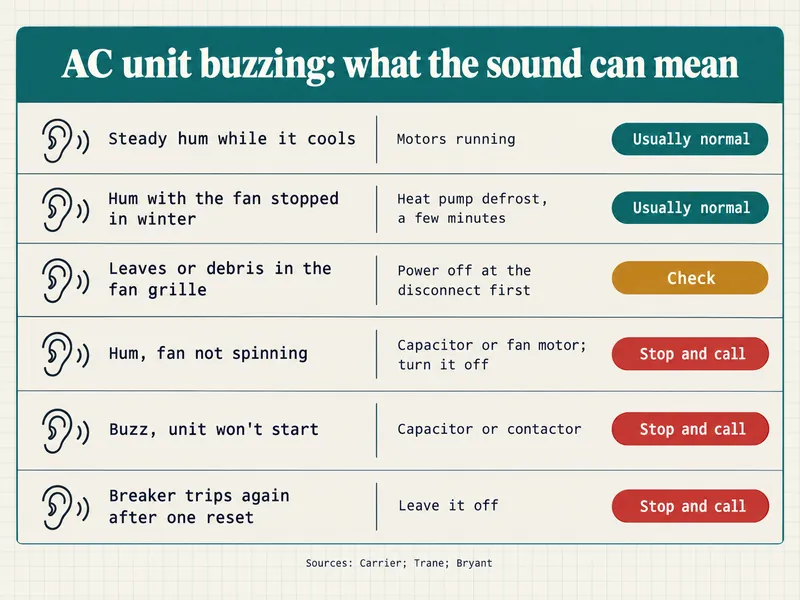
| Steady hum, fan spinning, cool air inside | Normal operation | None needed | The sound gets much louder than usual |
| Hum or buzz, fan not spinning | Failed capacitor or fan motor | Turn it off at the thermostat and breaker | Every time |
| Buzz, clicking, unit never starts | Capacitor, contactor or compressor start problem | Breaker and disconnect, one reset only | It buzzes again after power returns |
| Rattle or buzz with debris on top | Leaves or sticks in the fan | Power off at the disconnect, clear the top grille | The noise stays after clearing |
| Hum with fan stopped, steam, in winter | Heat pump defrost | Wait up to about 15 minutes | Defrost repeats constantly or ice builds up |
| Hissing at the refrigerant lines | Possible refrigerant leak | Turn the system off | Every time |
Is a buzzing AC unit dangerous to run?
Yes, to the equipment, and the parts involved are dangerous to touch. Carrier says to "turn off the system rather than allowing it to continue running," because running without a working condenser fan "can cause the compressor to overheat." Bryant lists buzzing, clicking or grinding from the outdoor unit among its signs to stop and call a professional.
If you smell burning, see smoke or scorch marks, or the breaker trips, the problem is electrical as well as mechanical: leave the power off and call. Smoke or flames mean get out and call 911.
What can you safely check?
Power, settings and the outside of the unit are yours; the electrical box is not. Follow the order on the 10-minute safe checks list and stop at the cabinet.
- Turn it off. Set the thermostat to Off.
- Thermostat. Confirm the mode is Cool, the setpoint is below room temperature, and the fan is on Auto.
- Breaker and disconnect. Check the AC breaker in the panel and the disconnect box near the outdoor unit. A tripped breaker gets one reset; if it trips again, leave it off and call.
- Filter. Carrier lists a clogged filter among the reasons an AC fan won't spin. Swap a dirty one; check it monthly and don't leave a 1-inch filter in past 3 months.
- Debris, power off. With the disconnect or breaker off, as Bryant's repair page requires, clear leaves and sticks from the top grille and keep plants at least 2 feet from the sides, per Trane.
- Restore power once. Turn power back on, set Cool, and listen. If it still hums with the fan still, turn it off again and call.
Never push the fan blade to start it, reach through the grille, or open the unit's service panel. Bryant's warning is direct: never remove electrical access panels or "attempt to test capacitors, compressors, contactors, or other internal components yourself."
Stop and call if
- The outdoor unit hums or buzzes and the fan does not spin
- The unit buzzes or clicks but never starts cooling
- A second breaker trip follows the single reset
- You smell burning or hot plastic, or see scorch marks or smoke (smoke or flames: get out and call 911)
- You hear hissing at the copper refrigerant lines
- If you're unsure, stop and call a licensed HVAC technician.
Why are capacitors a technician's job?
Because they can shock you after the power is off. Carrier's capacitor page warns that capacitors store high-voltage electricity "that can cause serious injury or death, even when the power is disconnected." Goodman's installation manual for its inverter units tells technicians to wait 10 minutes after shutting power off and confirm residual voltage is 50 volts or less, and notes that wind spinning the fan blade can charge the capacitor.
Leave capacitor and contactor work to a licensed technician. They confirm which part failed and match the replacement to the unit. Some units also take a hard-start kit; Lennox lists one as an accessory for conditions such as low voltage, not a routine part and not a cure for a failing compressor.
The listings below are technician parts. They show what a capacitor and a hard-start kit look like and how they are specified, not something to buy and fit yourself.
Which buzzing sounds are normal?
A steady hum while the unit runs, and some startup and shutdown noise, are normal. Trane notes that some outdoor units are "naturally loud when starting and stopping," and that during heat pump defrost the unit hums "while the fan is stopped," which is normal. Defrost usually lasts a few minutes, up to about 15, sometimes with steam and a whoosh; see heat pump defrost mode.
What changes the answer is a change. Trane's advice: if a normally quiet unit "suddenly starts making a loud noise, shut the system off and call for HVAC repair." For a furnace, Trane says "buzzing is louder than the everyday humming."
Tell the technician
What you heard
Hum, buzz or click; steady or pulsing; from the top fan area or the side panel.
What the fan did
Still, slow, or spinning; and whether the indoor blower was running.
Power history
Breaker trips, the one reset, storms or outages before it started.
What you checked
Thermostat mode, filter, debris cleared with power off, unit left off since.
Readings
- 30 minBryant's wait after switching off the breaker, "for the internal charge to dissipate"Bryant
- 50 VResidual voltage Goodman's inverter manual says to confirm before touching the charged areaGoodman IOD-4013M
- 10 minGoodman's wait in the same manual after shutting the power downGoodman IOD-4013M
- 75%Motor speed at which a relay drops the start capacitor out of the circuitCarrier
- 2 ftClearance Trane suggests between plants and the sides of the outdoor unitTrane
Case notes
Based on Carrier's AC fan and capacitor pages, Trane's HVAC noise, furnace noise and AC troubleshooting pages, Bryant's AC repair and AC-not-turning-on pages, Lennox's capacitor page and EL16KC1 specifications, and Goodman installation manual IOD-4013M, all read in October 2026. Left out: any capacitor testing or discharge steps, capacitor ratings, the stick trick on one maker's FAQ (it contradicts that maker's own warning), and part or repair prices.
Asked at intake
Why does my AC hum for a few seconds and then click off?
Bryant notes a failing capacitor can make a system struggle to start, hum loudly, or repeatedly shut off before completing a cooling cycle. Turn it off and call rather than letting it keep trying.
Can a buzzing AC unit start a fire?
A failing electrical part can overheat, which is why Bryant warns that repeatedly resetting a tripping breaker can create a fire hazard. If you smell burning or see scorch marks, leave the power off; with smoke or flames, get out and call 911.
Should I spin the fan blade to get it going?
No. The blades are inside a guard over live parts, and a capacitor can hold a charge. Leave the unit off and let a technician find out why the motor won't start.
My AC buzzes only during thunderstorms or after a power outage. Why?
Bryant names electrical interruptions and safety lockouts among the usual reasons an AC won't run. Reset a tripped breaker once; if the hum returns, call.
Does a hard-start kit fix a buzzing AC?
Not on its own. Lennox lists it as an accessory for conditions such as low voltage, not a routine fix, and fitting one is technician work.
Can a buzzing outdoor unit mean a refrigerant problem?
A buzz is electrical or mechanical; Trane treats a hiss at the copper lines as the refrigerant warning sign. EPA allows only Section 608-certified technicians to buy refrigerant for home systems, so a leak is never a homeowner refill job.
Nearby symptoms