Furnace Banging Noise When It Starts
Furnace banging noise when it starts? Pops from ducts warming up are common, but a single boom at the furnace itself can be delayed ignition, so turn it off and call a technician.
Checked against makers' and agencies' documents by Hum Drip Hiss · how pages are made · Updated
Vitals
- Trane says "a sudden bang at the furnace when it first starts up" could be delayed gas ignition and "needs immediate attention" (Trane).
- Banging or clanging heard at the registers is usually the ducts adjusting to temperature changes, per the same Trane page.
- Carrier puts it plainly: a bang or boom on startup "requires professional diagnosis" (Carrier).
- CPSC wants CO alarms on every level of the home and outside sleeping areas, and a heating system inspected once a year.
- Any noise plus a rotten-egg smell means leave the house first; phone for help only once you are well away.
Two different things make a furnace bang: ducts flexing as they warm, which is harmless, and gas lighting late inside the furnace, which is a safety problem.
What causes a furnace banging noise?
The most common cause is the ductwork, not the furnace. Trane describes "a slight pinging or popping" from ducts as they expand when the heat first comes on, and says banging or clanging from the registers is the ducts adjusting to temperature changes.
The less common cause is delayed ignition. Goodman's service manual defines it as "a delay in lighting a combustible mixture of gas and air which has accumulated in the combustion chamber." Carrier links a bang or boom at startup to a clogged burner that delays ignition. Trane adds a third, milder sound: a loud rumble when the furnace starts can come from dirty gas burners, which a technician cleans during maintenance.
How can you tell duct pops from a burner boom?
Listen for where the sound comes from and when it happens. Duct noise comes from the ceiling, walls or registers, often a minute or so after the burners light, when the blower starts pushing warm air; Carrier notes some furnaces wait about 30 to 60 seconds before the blower starts. Trane's noises page says ducts ping as they expand and contract, so a tick after the cycle ends is part of the same pattern.
A delayed-ignition boom comes from the furnace cabinet itself, in the first seconds of a cycle, at the moment the burners light. It is usually one sharp thud rather than a run of pings. If you can't tell which you're hearing, treat it as the boom until a technician says otherwise.
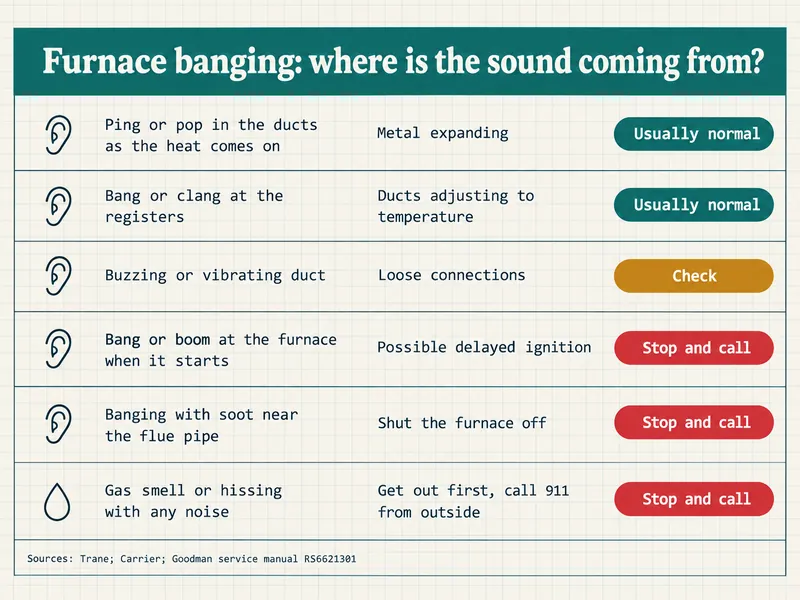
| Sound | Where you hear it | Likely cause | What to do |
|---|---|---|---|
| Pinging or popping as heat comes on | Ducts, walls, ceiling | Metal expanding as it warms | Usually normal; mention it at the yearly check-up |
| Banging or clanging | Supply registers | Ducts adjusting to temperature | Usually normal |
| Buzzing or vibrating | Duct runs | Loose duct connections | Not an emergency; ask a technician about sealing |
| Loud rumble at startup | Furnace | Dirty gas burners | Ask for burner cleaning at maintenance; leave the burner area closed |
| One bang or boom as burners light | Furnace cabinet | Possible delayed ignition | Turn the furnace off and call |
| Banging with soot near the flue | Furnace and flue pipe | Combustion or venting problem | Turn the furnace off and call |
Is a furnace banging noise dangerous?
Duct pops are not dangerous; a boom at the burners can be. Trane says a startup bang "needs immediate attention," and its noises page says that when banging comes with short cycling or soot around the furnace or flue pipe, you should call and "shut off your furnace in the meantime to help prevent carbon monoxide and flue gases from entering your home."
As a backstop, the CPSC asks for CO alarms on every level of the home and outside sleeping areas. If a CO alarm sounds, or anyone has a headache, dizziness, nausea or confusion, get everyone outside to fresh air and call 911 or the fire department from outside. Don't go back in until responders say it is safe. The CO alarm page covers alarm sounds and chirps.
What can you safely check?
You can check the outside of the system and the thermostat; everything behind the burner door is for a technician. More detail on each: safe checks.
- Note when it bangs. Think back over recent cycles rather than standing by the furnace to make it happen again. A bang in the first seconds, at the furnace, points to the burners; pops a minute later in the ducts point to the metal.
- Check the filter. Pull it out and look. ENERGY STAR says to check it monthly; a grey, clogged one goes, as does any 1-inch filter that has been in place 3 months, sooner if its maker says so.
- Open registers and clear returns. Trane's first steps for airflow noises are a clean filter, open registers, and returns not blocked by furniture.
- Make sure the front panel is seated. Many furnaces have a door switch that cuts power when the panel is off. Push the panel firmly into place; don't remove it.
- Look, without touching, for soot on the furnace, the flue pipe or the wall behind it. Soot means stop and call.
- Test your CO alarms with the test button and check the replace-by date printed on each one.
If the bang came from the furnace, set the thermostat to Off and flip off the furnace's own power switch, a plain wall-type toggle mounted on or beside the cabinet. Leave the gas controls alone.
Stop and call if you notice
- One bang or boom from the furnace as the burners light, even once
- Soot on the furnace, the flue pipe or the wall behind it
- Banging along with short cycling or a metallic smell
- A carbon monoxide alarm sounds: get everyone outside first, then call 911 from outside
- A rotten-egg smell or hissing near the gas line: get everyone out now, without flipping switches, using phones, lighting anything or touching the meter; once well away, phone 911 or the gas utility's emergency line (often both). The gas smell page has the full steps
- Scorch marks around the burner opening or the panel
- If you're unsure, stop and call a licensed HVAC technician.
Is delayed ignition a job for a technician?
Yes: the fixes are all inside the burner and gas controls, which homeowners should not open. Goodman's manual lists improper gas pressure and improper burner positioning among the checks, and warns: "Never by-pass or alter furnace controls." Measuring gas pressure and setting burners takes gauges and training.
The safety controls also need a trained eye. Carrier's 58SU manual describes manual-reset switches that shut off the gas valve when flames roll out or the gas control area overheats, and says "DO NOT bypass the switches." Rheem adds that no one should reset one "without identifying and correcting the fault condition." The furnace won't ignite page explains the rest of the ignition chain.
What should you tell the technician?
Write these down before you call.
Tell the technician
When it bangs
At startup, as the blower comes on, or after the cycle ends, and how many seconds in.
Where it comes from
The furnace cabinet, one duct run, or the registers in one room.
What else you noticed
Soot, a smell, short cycles, a CO alarm or a blinking light; give the blink count from the label.
What you already checked
Filter, registers, panel seated, power switch off since the bang.
Readings
- 1 bangA sudden bang at the furnace on startup "needs immediate attention"Trane
- 30–60 sBlower delay after the burners light on some furnaces, when duct pops often startCarrier
- 1 a yearHow often furnaces need inspection and service by a licensed professional, at leastNFPA Educational Messages 2026
- 4–15 minWhen a UL 2034 alarm must sound at 400 ppm of CO, as quoted in one First Alert manualFirst Alert SMCO110V-AC manual
Case notes
This page draws on Trane's furnace noise and HVAC noise pages, Carrier's furnace troubleshooting and cold-air pages, Goodman service manual RS6621301, Carrier's 58SU and Rheem RA 80+ installation instructions, the CPSC carbon monoxide safety page and NFPA's 2026 educational messages, all read in October 2026. Left out on purpose: any step inside the burner compartment, gas-pressure figures, repair costs, and the trade nickname for duct popping, because no maker source uses it.
Asked at intake
Why does my furnace bang only on the first cold morning?
Trane says ducts ping and pop as they expand when the heat first comes on. A boom from the cabinet on any morning is different and needs a technician.
Can a dirty filter cause a furnace to bang?
Carrier says a clogged filter can overheat the heat exchanger and trip the limit switch, which shuts the burners off. That is a different problem: a filter does not cause delayed ignition, so a boom still needs a call.
Is it safe to keep running a furnace that booms once at startup?
No. Trane says a startup bang needs immediate attention, and Carrier says it requires professional diagnosis. Set the thermostat to Off, turn off the furnace switch, and use another safe heat source until a technician has looked at it.
My furnace bangs when it shuts off, not when it starts. Is that the same?
A pop or tick after the cycle ends is usually the ducts contracting as they cool. If the sound is a boom from the furnace itself, treat it like a startup bang.
Will a CO alarm warn me about delayed ignition?
A CO alarm warns about carbon monoxide in the air, not about the boom itself. It is still the backstop if a combustion problem lets flue gases into the house, which is why CPSC asks for alarms on every level and outside sleeping areas.
Why does Goodman call delayed ignition unlikely?
Goodman's service manual says furnace design makes it "extremely unlikely unless safety controls have been by-passed or tampered with." That is why its advice is never to bypass or alter furnace controls, and why a boom soon after anyone has worked on the controls deserves a fast call.
More sounds and next steps
Back to the six symptom folders