Furnace Blinking Red Light
A furnace blinking red light is a fault code: count the flashes, write the pattern down and match it to the label on your furnace's door, because the same count means different things on different brands.
Checked against makers' and agencies' documents by Hum Drip Hiss · how pages are made · Updated
Vitals
- Red blinking lights "generally signal a problem", while a slow green blink can simply mean no call for heat, per Trane.
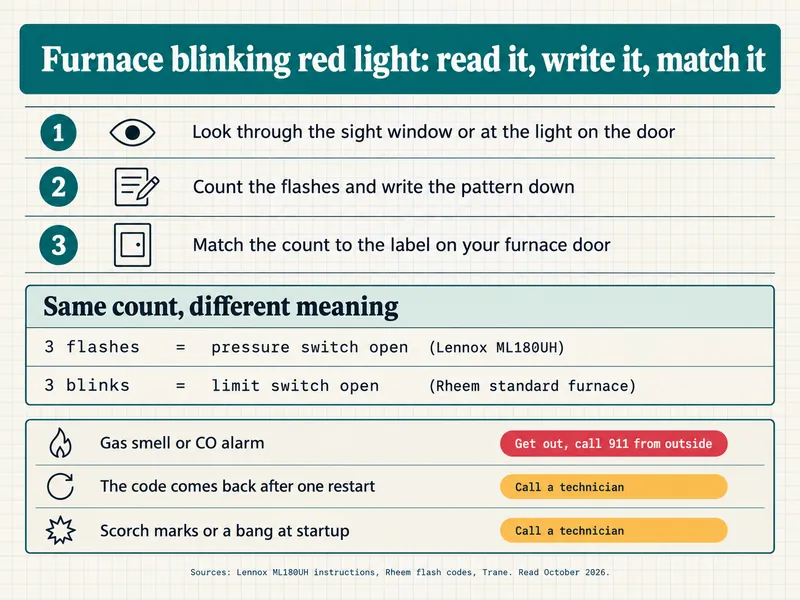
- Codes are not universal: 3 flashes means "pressure switch open" on a Lennox ML180UH but "limit switch open" on a Rheem standard furnace.
- The Lennox ML180UH control stores its last 5 fault codes, so the history can survive a power loss.
- Carrier's 58MVP furnace clears an ignition lockout by itself after 3 hours.
- A dirty filter behind a limit code is the one cause here you can fix yourself; check it monthly and replace it at least every 3 months for 1-inch filters (ENERGY STAR).
- Restart at most once after writing the code down; if the same code returns, leave the furnace off and call.
Stop and call if
- You smell gas or rotten eggs: get everyone out first, then call 911 or the gas utility from outside.
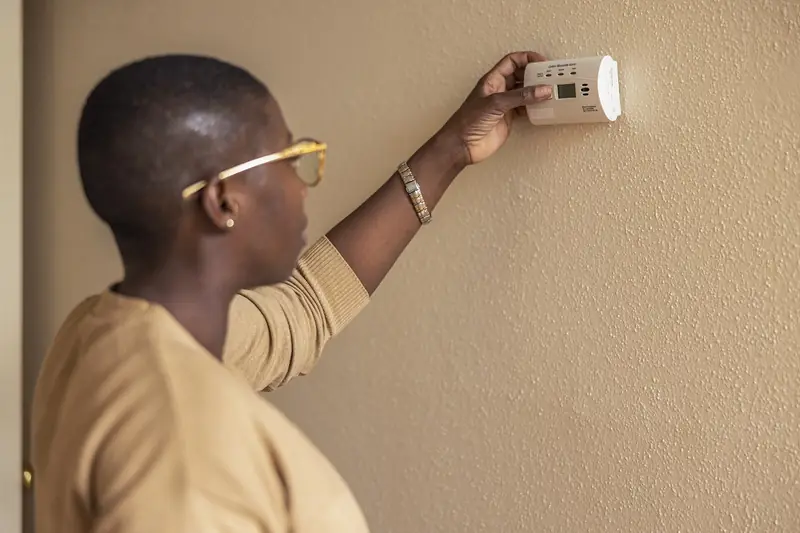
- A CO alarm sounds, or anyone feels headache, dizziness or nausea: go outside and call 911.
- The same code returns after one restart, or the furnace locks out again.
- You hear a bang or boom at the furnace when it lights, or see scorch marks or soot.
- The code points to the rollout, limit or pressure switch more than once in a day.
- If you're unsure, stop and call a licensed HVAC technician.
What does a furnace blinking red light mean?
A furnace blinking red light means the control board has found a fault and is reporting it as a count of flashes. Trane puts it plainly: red blinking lights "generally signal a problem", and the right move is to note the pattern before doing anything else. A green light is a different story; a slow green blink on many models only means the thermostat is not calling for heat.
The light narrows the fault to an area (airflow, ignition, venting, power); a licensed technician then tests the part. Trane warns homeowners not to fix the furnace themselves because of the electrical hazard and the risk of hazardous gases. A blank thermostat is a separate problem, covered on thermostat blank.
How do you read the blink code?
You read the blink code by counting the flashes in one burst, waiting for the pause, and counting again to confirm. Then match that count to the code label on the furnace door or blower panel. Carrier's service documents tell technicians to "See Service Label on blower access panel" for the meaning, which is the same label you can read.
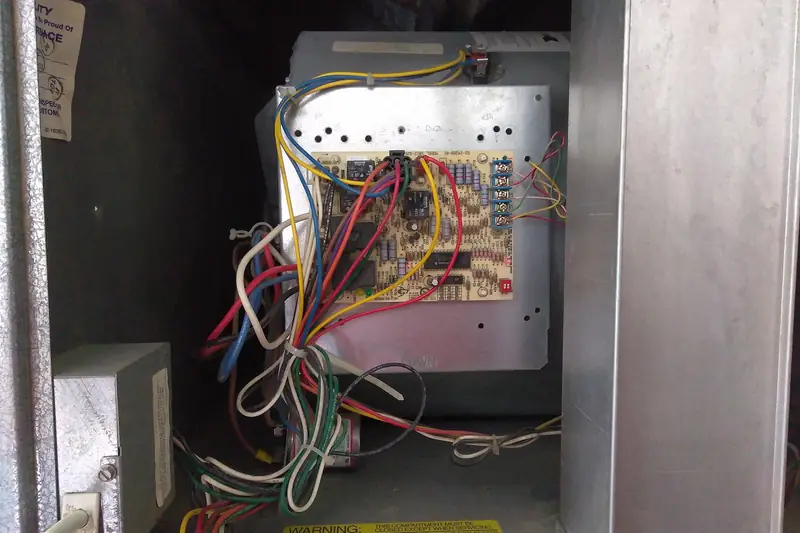
- Look at the light through the small sight window in the lower door. Don't remove panels to get a better view.
- Count two or three bursts. Note the color, whether it is steady or flashing, and whether some flashes are long and some short.
- Write the pattern down or take a short phone video of it.
- Match the count to the label on your own furnace door. If the label is missing or faded, the owner's manual for your model lists the codes.
Keep the panel on. Many furnaces have a door switch that cuts power and gas when the door comes off, which turns the light off too, and Carrier says to remove the door only if your owner's manual permits homeowner access.
Some codes take two digits. On Carrier's 58MVP furnace, the status codes are two-digit numbers: the short flashes give the first digit and the long flashes give the second, and the light on that model is amber, not red. That is why "it blinked 3 times" is not enough on its own.
Which codes point to airflow or the filter?
Codes for an open limit switch usually point to airflow, and airflow is the one cause you can often fix yourself. On the Lennox ML180UH, 4 flashes means "Primary limit switch open". On a Rheem standard furnace, 3 blinks means "Limit Switch Open". Same idea, different count.
The limit switch shuts the burners off when the furnace overheats; Carrier explains that a clogged filter can cause exactly that while the fan keeps running. The safe checks:
- Turn the thermostat to OFF.
- Pull the filter. If it is gray and matted, replace it with the same size.
- Open closed supply registers and clear furniture or rugs off return grilles.
- Turn the thermostat back to HEAT and watch one full cycle.
If the limit code comes back with a clean filter and open vents, the cause is inside the cabinet (a blower problem, a blocked flue or a duct restriction). That is a technician's job. The safe checks list walks through the same steps in order, and furnace blowing cold air covers the fan-runs-but-no-heat pattern a limit trip often causes.
Which codes point to ignition or gas?
Pressure switch and lockout codes point to the ignition sequence, and nothing in that sequence is safe for a homeowner to touch. The Lennox ML180UH uses 3 flashes for "Pressure switch open with combustion air inducer energized" and 7 flashes for "Lockout, burners fail to light". Rheem's standard furnaces use 2 and 4 blinks for pressure switch faults and 1 blink for a soft lockout that lasts 1 hour.
A furnace starts in order: inducer fan, igniter, gas valve, then the flame sensor proves the flame. If any step fails, the control closes the gas valve and shows a code. Carrier states that bypassing or removing the flame sensor is dangerous, and Rheem's user manual says not to jumper the pressure switch.
What you can check: the thermostat is on HEAT with a setpoint above room temperature, the furnace switch is on, and other gas appliances in the home are working. If none of them light, the gas supply may be off and the utility is the call. The details of a no-ignition furnace are on furnace won't ignite.
Should you reset the furnace?
Reset once at most, and only after you have written the code down. Some controls clear lockouts themselves: Carrier's 58MVP furnace notes "IGNITION LOCKOUT – Control will auto reset after 3 hours." No maker page found gives homeowners a lockout reset routine beyond that.
If you choose to restart, turn the thermostat off, switch the furnace off at its service switch, wait a minute, then switch it back on and set the thermostat to HEAT. If the same code returns, leave it off. Cycling power over and over does not fix the fault, and the safety controls are there to stop a furnace that is failing to light; a repeat lockout also gives the technician a pattern worth reporting.
Never restart a furnace after a boom at startup or with a gas smell nearby; those go straight to stop and call.
What should you tell the technician?
Tell the technician the exact pattern, the furnace's brand and model number, and what you already checked.
Tell the technician
The pattern
Color, count, long or short flashes, steady or flashing, and whether a video is available.
The model
Brand, model and serial number from the rating plate, plus the code label text.
The timeline
When it started, whether heat came on at all, and how many times it locked out.
What you checked
Filter, thermostat mode, furnace switch, other gas appliances, and any one restart.
When you call a company, look at how its heating service page describes what it does. Central Plumbing & HVAC's heating page (Central Plumbing & HVAC, a business tied to Hum Drip Hiss) is one example of how a local company lays out its furnace work; it serves only Bucks and Montgomery counties in Pennsylvania, so use it as a model of what to look for on any company's page.
Readings
- 3flashes: "pressure switch open" on the Lennox ML180UHLennox
- 3blinks: "limit switch open" on Rheem standard furnacesRheem
- 5last fault codes stored by the ML180UH controlLennox
- 3 hoursuntil a Carrier 58MVP ignition lockout clears itselfCarrier
| Furnace | Code | What the maker's label says | Safe check | Stop and call if |
|---|---|---|---|---|
| Lennox ML180UH | 3 flashes | Pressure switch open, inducer running | Thermostat on HEAT, switch on | Code returns after one restart |
| Lennox ML180UH | 4 flashes | Primary limit switch open | Filter, registers, returns | Code returns with a clean filter |
| Lennox ML180UH | 7 flashes | Lockout, burners fail to light | Other gas appliances working | Any gas smell, or lockout again |
| Rheem standard | 1 blink | Soft lockout (1 hour) | Write it down, wait | It locks out again |
| Rheem standard | 3 blinks | Limit switch open | Filter, registers, returns | Code returns with a clean filter |
| Carrier 58MVP | 14 | Ignition lockout, auto reset after 3 hours | Write it down | It locks out again |
Case notes
This page is based on Trane's blinking-light troubleshooting page, Carrier's furnace pages and its 58MVP and 58SU service literature, the Lennox ML180UH installation instructions (507323-01), Rheem's standard gas furnace flash code list and Rheem's M2 user manual, and the ENERGY STAR maintenance checklist, all read in October 2026. The code examples are shown only to prove that counts differ by brand. Left out: any homeowner procedure inside the burner or control compartment, any lockout routine beyond one restart, and repair costs.
Asked at intake
Why is my furnace blinking red but still running?
Some codes describe a fault that comes and goes, so the furnace may still light on later tries. Write the count down and match it to the label. If heat stays normal, mention the code at the next yearly service; if it repeats or heat stops, call sooner.
Does a solid red light mean the same as a blinking one?
No. On some controls a steady light means power is present: Carrier's 58MVP literature describes "CONTINUOUS ON" as the control having 24-volt power. Check your own label, because a steady light can mean something else on another model.
Can a furnace code clear itself after a power outage?
The light may stop, but the history often stays. The Lennox ML180UH keeps its last 5 fault codes in memory, so a technician can still read what happened. Carrier's 58MVP erases stored codes after 72 hours.
Will replacing the filter clear a limit code?
It often removes the cause, and the furnace may then run normally on the next call for heat. If the limit code returns with a clean filter and open vents, the restriction is somewhere a technician needs to look.
My furnace has no code label. Where are the codes?
Look in the owner's manual or the installation instructions for your exact model, which list the codes in a table. The model number is on the furnace's rating plate.
Is it safe to keep running a furnace that shows a fault code?
If the furnace has locked out, it won't run anyway. If it runs between codes, the light is still telling you a safety or sensor check failed, so book a licensed technician soon. Any gas smell, CO alarm, scorch mark or bang at startup means turn it off and follow the steps on the stop-and-call page.
Related pages
Back to the six symptom folders