Furnace and AC Short Cycling
Furnace short cycling means repeated cycles of only a few minutes, usually from a dirty filter, a thermostat in the sun or near a heat source, an overheating furnace, or equipment too large for the house.
Checked against makers' and agencies' documents by Hum Drip Hiss · how pages are made · Updated
Vitals
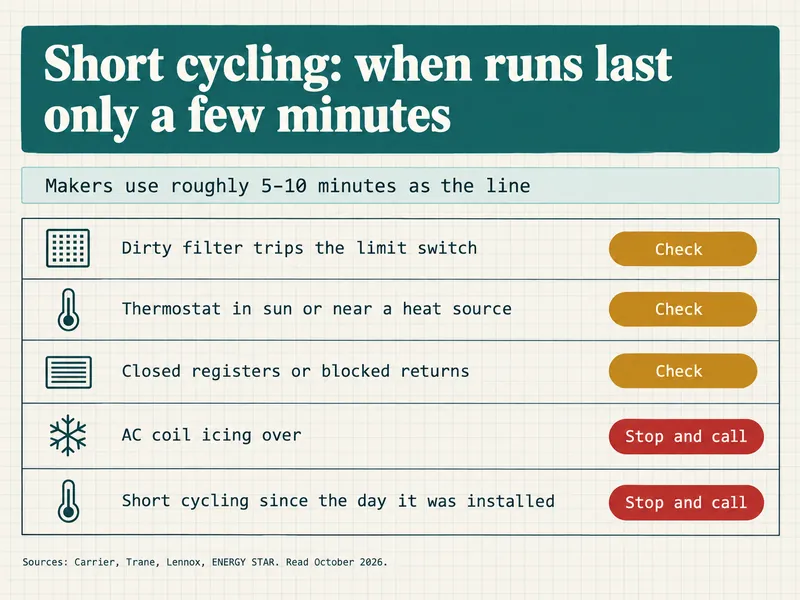
- Makers use roughly 5 to 10 minutes as the line: Carrier says short cycles are "often less than 5 to 10 minutes", Lennox says under 5, and Trane says a furnace cycle is generally at least 7.
- A clogged filter can trip the furnace's limit switch, which shuts the burners off to protect the heat exchanger.
- Trane notes that a thermostat in direct sunlight can turn the heat off early.
- ENERGY STAR says oversized equipment "may cycle too frequently", with less comfort and a shorter lifespan.
- One Florida study found cooling electricity rose a typical 9% when units were oversized by 50% or more.
- Check the filter monthly and replace it at least every 3 months for 1-inch filters.
What is furnace short cycling?
Furnace short cycling is the system turning on and off over and over in runs of only a few minutes. Makers draw the line in slightly different places: Carrier describes cycles "often less than 5 to 10 minutes", Lennox says a furnace that shuts off in under five minutes could be short cycling, and Trane says a furnace cycle will generally be at least 7 minutes long.
Context matters. Trane points out that on a very cold night, frequent cycling can be normal because the house is losing heat quickly. The pattern to watch is short runs on an ordinary day, the house never quite reaching the setpoint, or the burners lighting and going out again within a minute or two.
What causes furnace short cycling?
The usual causes are overheating from poor airflow, a thermostat reading the wrong temperature, and a furnace that is too big for the house. Carrier lists a dirty filter as a leading cause: it restricts airflow, heat builds up, and the limit switch shuts the burners off to keep the heat exchanger from overheating. Once it cools, the furnace lights again, and the loop repeats.
Thermostat placement is next. A thermostat in direct sunlight, above a lamp, beside a supply register or near a kitchen reads warm and ends the cycle before the rest of the house is heated. Trane says that sun alone can turn off the heat regardless of the temperature elsewhere.
Some causes are inside the furnace. Lennox names a dirty flame sensor, which can make the burners shut off soon after lighting, and Trane says to make sure the exhaust flue and vent pipe are not blocked. Both are for a licensed technician: Carrier states that internal parts such as the flame sensor should be maintained by a trained professional. If your furnace shows a blinking code during these cycles, read it first on furnace blinking red light.
What causes AC short cycling?
AC short cycling usually comes from an oversized system, an icing coil, a tripped drain safety switch, or the same thermostat placement problems that affect furnaces. ENERGY STAR's older paper on right-sized air conditioners explains that oversized units "short-cycle" and that an air conditioner reaches peak efficiency only after about 10 minutes of running.
Restricted airflow is the second branch. A dirty filter or a couch over a return grille starves the indoor coil of warm air, and Trane explains that the coil can then freeze. A freezing coil can stop cooling altogether; see frozen AC coil for how to thaw it safely.
Water is the third. Many indoor units have a drain pan float switch, which Trane describes as a safety switch that shuts down the system when water rises. A partly blocked drain can make the AC stop without warning. AC leaking water inside covers flushing the drain.
Is short cycling harmful?
Yes, over time. ENERGY STAR says oversized equipment that cycles too often brings less comfort and a shortened lifespan. In cooling, it also leaves humidity behind: ENERGY STAR explains that an AC has to run long enough for moisture to condense and drain off the coil.
A limit-switch trip is the furnace protecting itself, but a furnace that trips it again and again is running hot. Carrier describes this as shutting the system down to keep the heat exchanger from overheating, so the fix is airflow or a service call, not a reset. If the house feels clammy in summer, humidity too high explains the EPA's 30 to 50% target.
What can you check yourself?
You can check the filter, the thermostat, the vents and the drain. Do them in this order and watch a few cycles after each one.
- Filter. Turn the system off at the thermostat, pull the filter and replace it if it looks dirty. ENERGY STAR's maintenance checklist says to inspect it monthly.
- Thermostat. Look for sun, lamps, a nearby register or a drafty door. Check the batteries and that the mode is HEAT or COOL with the fan on AUTO.
- Registers and returns. Open closed supply registers and clear furniture, rugs and drapes off returns. A Lawrence Berkeley National Laboratory study warned that closing more than 60% of registers can make furnaces run on the high-limit switch.
- Condensate (AC). With power off, look for water in the drain pan under the indoor coil. If there is standing water, the drain may need flushing with distilled vinegar.
- Outdoor unit (AC). Switch it off at the disconnect, then clear leaves and debris from the sides and top.
Stop there. Don't open the furnace burner compartment, don't touch the flame sensor or limit switch, and never jumper or bypass a safety switch. The safe checks page lists where each check ends.
When is oversizing the cause?
Oversizing is the likely cause when the system has short cycled since the day it was installed. Trane says that if a furnace has been short cycling since installation, it may have been improperly sized for the home. A sized-right system runs longer, steadier cycles.
Sizing should come from a load calculation, not a rule of thumb. ACCA's Manual J is the ANSI-recognized standard for sizing loads in homes, and ENERGY STAR tells homeowners to make sure the contractor uses the actual characteristics of the home. A 2002 DOE and NREL paper warns against sizing by floor area or a contractor's "experience", and cites a Florida study with a typical 9% rise in cooling electricity for units oversized by 50% or more.
You can't fix oversizing with settings. A technician can compare the equipment's capacity with a Manual J calculation for your house, and that is worth asking for before any replacement.
Stop and call if
- You smell gas, or a CO alarm sounds: get everyone outside, then call 911 or the gas utility from outside.
- You see soot near the furnace or vent, or smell burning plastic.
- The burners light and go out again within seconds, cycle after cycle.
- Short cycling continues with a clean filter, open vents and a well-placed thermostat.
- Ice forms on the indoor coil or refrigerant lines.
- The breaker trips again after one reset.
- If you're unsure, stop and call a licensed HVAC technician.
Tell the technician
Cycle times
On and off times for three or four cycles, and the outdoor temperature.
When it started
Since installation, after a filter change, after remodeling, or suddenly.
Codes and sounds
Any blink code count, clicks, or burners lighting and going out.
What you checked
Filter, thermostat spot and mode, registers, drain pan, outdoor unit.
Readings
- 5–10 mincycles shorter than this point to short cyclingCarrier
- 7 minTrane's minimum for a normal furnace cycleTrane
- 10 minrun time for an AC to reach peak efficiencyENERGY STAR (2005)
- 9%more cooling electricity, units oversized 50%+ (Florida study)DOE / NREL (2002)
- 60%registers closed beyond which LBNL warned of high-limit operationLawrence Berkeley National Laboratory
| Cause | System | Safe check | Stop and call if |
|---|---|---|---|
| Dirty filter tripping the limit switch | Furnace | Replace the filter | It keeps cycling with a clean filter |
| Thermostat in sun or near heat | Both | Note its location | Cycling continues after that is ruled out |
| Closed registers or blocked returns | Both | Open and clear them | Rooms stay uneven with all open |
| Drain pan float switch tripping | AC | Look for water, flush the drain | Water returns or the pan overflows |
| Coil icing from low airflow | AC | Filter, returns, thaw with cooling off | Ice comes back |
| Oversized equipment | Both | Ask when it started | Short cycling since installation |
Case notes
This page uses the short-cycling pages from Carrier, Trane and Lennox, Trane's frozen-coil and air-handler pages, Carrier's flame-sensor page, ENERGY STAR's quality-installation page, maintenance checklist and 2005 right-sized air conditioner paper, the 2002 DOE/NREL right-size paper, ACCA's Manual J page and the Lawrence Berkeley National Laboratory register-closing study, read in October 2026. Older figures are dated where they appear. Left out: a single universal cycle length, specific sizing percentages, work inside the furnace or outdoor unit, and repair costs.
Asked at intake
How many times an hour should a furnace cycle?
No maker gives one number for every home. Use the length of each run instead: makers treat runs of only a few minutes (roughly 5 to 10) as short cycling. On a very cold night, Trane notes, more frequent cycles can be normal.
Can a high-efficiency filter cause short cycling?
The EPA suggests a filter rated MERV 13 or as high as your system can accommodate, and says a technician can tell you the highest rating that works for your fan and filter slot. If cycling starts right after a filter upgrade, ask about it.
Why does my furnace turn off before the house warms up?
The thermostat may be reading heat from sun, a lamp or a nearby register, or the limit switch may be cutting the burners because airflow is poor. Check the filter and the thermostat's spot first.
Is AC short cycling bad for humidity?
Yes. ENERGY STAR explains that an AC has to run long enough for moisture to condense on the coil and drain away, so short runs leave the air damp even when the temperature looks fine.
Can a heat pump short cycle in winter?
Yes, for the same reasons: airflow, thermostat placement or sizing. A heat pump also pauses for defrost in cold, damp weather, which is normal; see heat pump defrost mode for what that looks like.
What should I tell the technician about short cycling?
Time a few cycles with a clock and write down how long each run lasts and how long the system rests. Add the season it started, whether it happens in heating, cooling or both, the date of the last filter change and any blink code on the furnace. That record saves time on the visit.
More from this section
Back to all symptoms, by what you notice