Triage
Safe HVAC Checks Before You Call
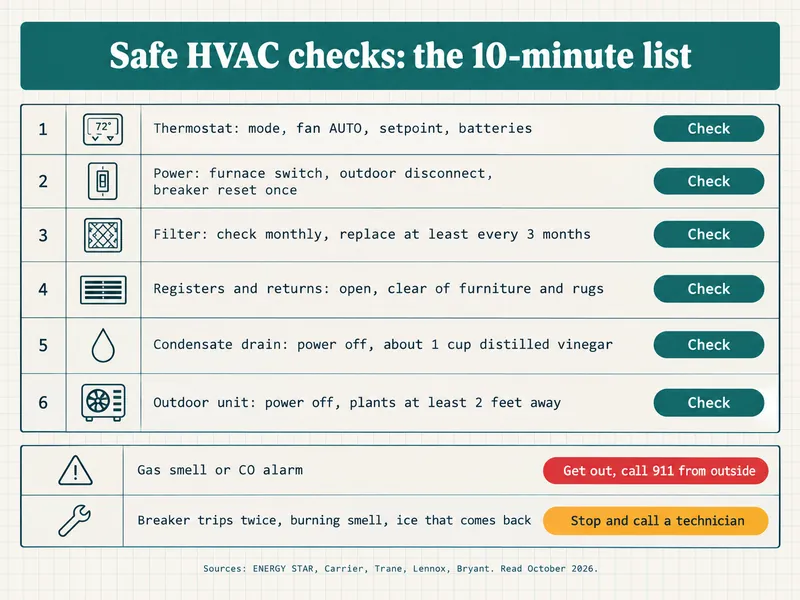
Safe HVAC checks take about ten minutes: thermostat, power, filter, registers and returns, condensate drain, then the outdoor unit, each with the power off where it matters and a clear point where the homeowner stops.
Checked against makers' and agencies' documents by Hum Drip Hiss · how pages are made · Updated
Vitals
- Carrier says an AC that isn't working is most often a tripped breaker, a wrong thermostat setting or a clogged filter, so those three come first.
- A tripped HVAC breaker gets 1 reset only; Lennox and Carrier say that if it trips again, a technician takes over.
- Check the filter monthly; replace it when it looks dirty, per the filter maker, and for 1-inch filters no later than every 3 months (ENERGY STAR).
- Carrier's drain-line steps use about 1 cup of distilled vinegar poured into the indoor access point, with the power off first.
- Trane advises keeping plants at least 2 feet from the sides of the outdoor unit and debris off its top.
- Bryant says safe homeowner troubleshooting ends before opening the equipment cabinet.
Stop the checks and call if
- You smell gas: leave the house first and call 911 or the gas utility from outside.
- A carbon monoxide alarm sounds: get everyone outside and call 911 from outside.
- The HVAC breaker trips again after you reset it once.
- You smell burning plastic or wiring, or see sparks or scorch marks.
- Ice on the coil or copper lines comes back after a full thaw.
- Water is reaching wiring, the furnace controls or an outlet.
- If you're unsure, stop and call a licensed HVAC technician.
Which safe HVAC checks can you do before calling?
Six safe HVAC checks cover most no-heat, no-cooling and odd-behavior calls: the thermostat, power, the air filter, registers and returns, the condensate drain, and the outdoor unit. Work in that order: the early ones are the commonest causes.
None of them involves removing a screwed-on panel, touching wiring or handling refrigerant. If a check turns up a gas smell, a burning smell, smoke, sparks or a sounding CO alarm, stop the list and follow the stop-and-call signs instead.
How do you check the thermostat?
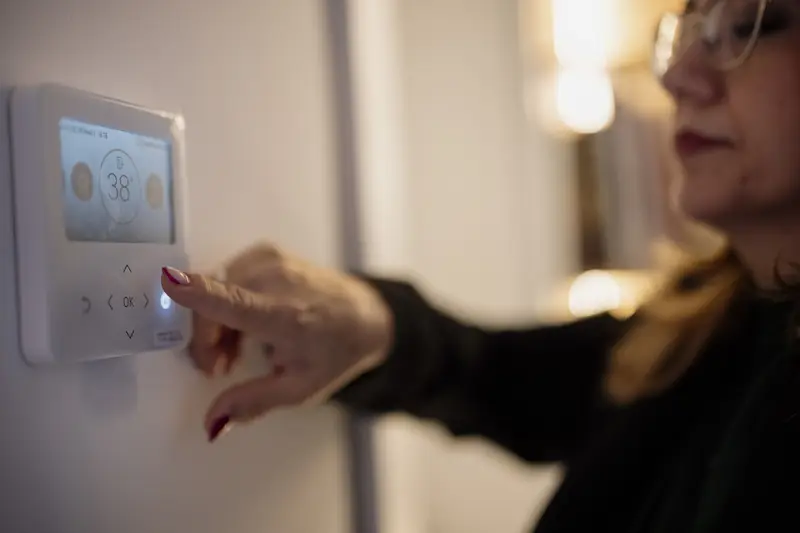
Check four things on the thermostat: mode, fan setting, setpoint and batteries. The mode should be COOL in summer and HEAT in winter, and the fan should be on AUTO; Trane notes that with the fan on ON, the system blows unconditioned air even when the AC isn't running.
For cooling, the setpoint must be below the room temperature; for heating, above it. If the screen is blank, Honeywell says to replace the batteries on battery-powered models and then check breakers, the furnace power switch and the furnace door switch. The blank thermostat page covers the rest, and the warm air page covers cooling that runs but doesn't cool.
How do you check power to the system?
Power reaches a typical split system in three places: the furnace switch, the breaker, and the outdoor disconnect. The furnace switch often looks like a light switch on or near the unit; the outdoor disconnect is a box on the wall near the condenser, and Carrier says to make sure it is switched on.
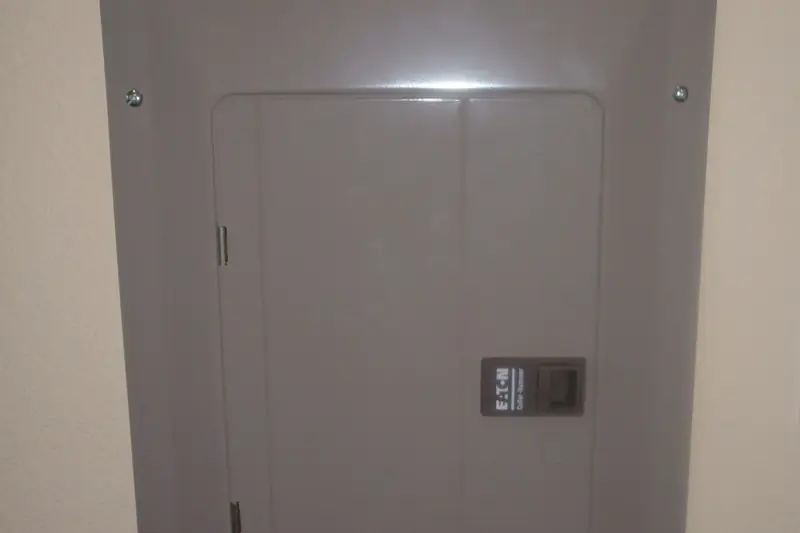
At the panel, look for a tripped breaker labeled for the furnace, air handler or AC. Reset it once. A second trip means it stays off and you call, because that points to an electrical or motor fault; don't open the panel's inner cover. Also confirm the furnace's front door panel is seated, since Trane says a blower door switch cuts power and gas when the door is off. The AC not turning on page goes further.
How do you check the air filter?
Slide the filter out and hold it to a light: if light barely passes or the surface is gray and matted, replace it. ENERGY STAR's maintenance checklist calls for a monthly inspection, cleaning or change of filters and warns that a dirty filter can increase energy costs and damage equipment.
A clogged filter starves the system of air: in cooling it can freeze the indoor coil, and in heating it can trip the furnace's limit switch. Match the new filter's size to the one printed on the old filter's frame.
Higher-efficiency filters help indoor air but add resistance. The EPA suggests at least MERV 13, or as high as your system fan and filter slot can accommodate, and says a technician can help find the highest rating that suits your system.
How do you check registers and returns?
Walk the house and make sure every supply register is open and every return grille is clear of furniture and rugs. Carrier says to open all heat vents and keep return-air grilles unobstructed, and Trane names a couch in front of a return as a common cause of a frozen coil.
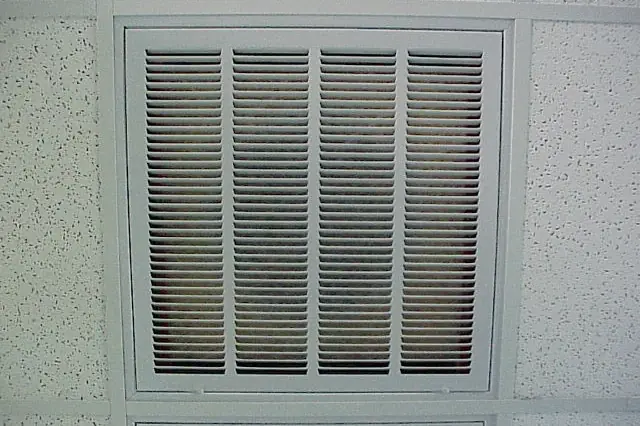
Closing registers in unused rooms rarely helps: a Lawrence Berkeley National Laboratory study of California houses found it increased energy use, and closing more than 60% can trip a furnace limit or freeze a coil. For rooms that stay too hot or cold, see uneven room temperatures.
How do you check the condensate drain?
Look first: water in the pan under the indoor coil, a puddle at the furnace or a damp drain line means the drain is slow or blocked. A float switch on some pans shuts the indoor unit down when the pan fills.
To flush the line, turn the power off at the thermostat and the furnace switch, empty or wet-vacuum the pan, then pour about 1 cup of distilled vinegar into the drain's access cleanout, as Carrier describes. Lennox also allows an approved cleaner made for PVC, left 30 minutes or longer before a water flush. Use only vinegar or the maker's approved cleaner.
Vinegar won't clear every clog, since some blockages are debris rather than growth. If water keeps returning, or it is near wiring, leave the system off and call; the indoor AC leak page explains the pump, trap and pan.
How do you check the outdoor unit safely?
Turn the power off at the outdoor disconnect (flip its handle or pull its block; don't remove the cover) or at the breaker first, then look from the outside only. Clear leaves, grass clippings, snow and toys from around the unit and off its top grille, and trim plants back at least 2 feet from the sides, as Trane advises.
Never remove the service panel: capacitors can hold a charge after the power is off, and Goodman's manual for one inverter unit says to wait 10 minutes before touching charged areas. Leave capacitor and contactor work to a licensed technician.
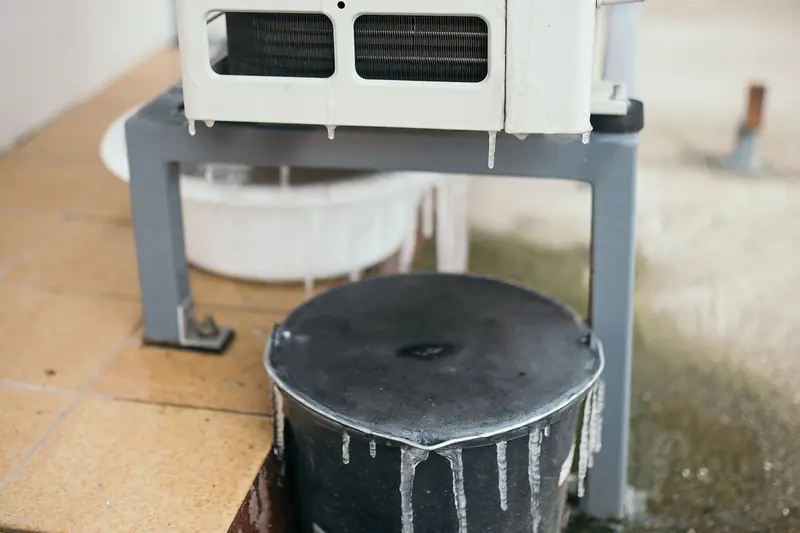
With power back on and the thermostat calling for cooling, the top fan should spin. If the unit hums but the fan doesn't turn, Carrier says to switch the system off rather than let it run. Ice on the outdoor unit in winter can be normal heat pump defrost; ice on an AC in summer belongs on the frozen coil page.
| Check | Problem result | What it usually means | Where the check ends |
|---|---|---|---|
| Thermostat | Fan on ON, wrong mode or blank screen | Setting or battery problem | Wiring or a blank screen with fresh batteries |
| Power | Tripped breaker or switch off | Power interruption | Breaker trips twice |
| Filter | Gray, matted, little light through | Restricted airflow | Ice or a limit trip after a new filter |
| Registers and returns | Closed or blocked by furniture | Restricted or unbalanced airflow | Rooms still uneven with all open |
| Condensate drain | Water in the pan or on the floor | Slow or clogged drain | Leak returns or water near wiring |
| Outdoor unit | Debris, or fan hums but doesn't spin | Airflow or motor problem | Any humming, ice in summer, service panel |
Numbers for the checks
- 1 monthbetween filter inspections on ENERGY STAR's checklistENERGY STAR
- 15%efficiency loss airflow problems can cause, at mostENERGY STAR
- 1 cupdistilled vinegar Carrier uses to flush a drain lineCarrier
- 30 minminimum soak Lennox gives a drain cleaner before flushingLennox
- 2 ftclearance Trane advises between plants and the outdoor unitTrane
When do the safe checks end?
The safe checks end at the cabinet: once all six are done and the problem remains, or the moment you would need a screwdriver, the next step is a licensed technician. Bryant warns never to remove electrical access panels or test capacitors, compressors, contactors or other internal parts.
They also end the moment a stop sign appears: breaker trips twice, gas or burning smell, or ice that comes back. The furnace blowing cold air page shows how a limit trip looks from the homeowner's side.
Case notes
This list follows homeowner troubleshooting pages from Carrier, Trane, Lennox and Bryant, Honeywell's thermostat support pages, a Goodman installation manual, the ENERGY STAR maintenance checklist, EPA's MERV page and a Lawrence Berkeley National Laboratory register study, all read in October 2026. Not covered here: steps inside an equipment cabinet, refrigerant work, thaw shortcuts using heat, duct damper settings and repair costs.
Asked at intake
How long do the safe checks take?
About ten minutes for most homes, longer if the drain flush needs its 30-minute soak or the outdoor unit needs clearing.
Do you need tools for the safe checks?
No tools beyond a flashlight, a towel and, for the drain, a wet/dry vacuum or a funnel. Anything that needs a screwdriver to open is past the point where homeowner checks end.
Should the system run while you check the filter?
No. Switch it off at the thermostat first, then back on with the new filter in.
Can you reset a breaker more than once if it is cold out?
No. One reset is the limit in any weather; a second trip means the breaker stays off until a technician has looked. Repeated resets can hide an electrical or motor fault.
What if the checks fix the problem?
Note what you changed and watch the system for a day or two. If the same symptom comes back, call, because the check may have cleared the symptom without curing the cause.
Is the condensate drain flush safe on a furnace in winter?
Yes, on a high-efficiency furnace that drains water, with the power off first and only vinegar or the maker's approved cleaner. A standard furnace with a metal flue makes no condensate of its own, so water there usually comes from the AC coil or a humidifier.
Related pages
Back to the six symptom folders