AC Blowing Warm Air
AC blowing warm air? Most often the thermostat is on FAN or HEAT, the filter is clogged, or the outdoor unit has lost power; ice on the coil and low refrigerant come next.
Checked against makers' and agencies' documents by Hum Drip Hiss · how pages are made · Updated
Vitals
- Carrier lists a tripped breaker, a wrong thermostat setting and a clogged filter as the three most common reasons an AC stops cooling.
- A fan set to ON instead of AUTO keeps blowing room air between cooling cycles, so the vents feel warm even when nothing is broken.
- If the indoor fan runs but the outdoor unit is silent, reset its breaker once; if it trips again, leave it off and call.
- Ice on the coil or copper lines means switch cooling OFF and let it thaw, which usually takes a few hours.
- Only EPA Section 608 certified technicians can buy refrigerant for home systems, so low refrigerant is never a homeowner fix.
- Carrier advises turning the AC off while it blows warm air, because running it can overheat the compressor.
Why is the AC blowing warm air?
An AC blowing warm air is usually a settings, airflow or power problem, and those three are the ones you can check yourself. Carrier names a tripped breaker, incorrect thermostat setting, or a clogged air filter as the causes to rule out first. After those come a frozen indoor coil, a dirty outdoor coil, and a refrigerant leak or failed part, which belong to a technician.
The quickest clue is the outdoor unit. If the indoor blower is pushing air but the condenser outside is quiet, the house is getting room air moved around, not cooled air. If both are running and the air is still warm, airflow or refrigerant is the likelier story. Work through the safe checks list in order before you call; it takes about 10 minutes.
Is the thermostat set right?
Start at the thermostat, because a wrong mode or fan setting is the cheapest cause to rule out. Trane says to set the fan to AUTO and make sure the temperature you have set is lower than the current indoor temperature. With the fan on ON, the blower keeps running after each cooling cycle ends and sends unconditioned air through the vents.
- Set the mode to COOL, not HEAT, AUTO changeover or FAN.
- Set the fan to AUTO.
- Set the temperature a few degrees below the room reading and wait a few minutes.
- If the screen is dim or blank, replace the batteries; a dead thermostat is covered on the blank thermostat page.
Then pull the filter. ENERGY STAR says to inspect, clean, or change air filters once a month; the rule here is to replace it when it looks dirty, per the filter maker, and at least every 3 months for 1-inch filters. A clogged filter starves the coil of air and can lead to ice.
Is the outdoor unit running?
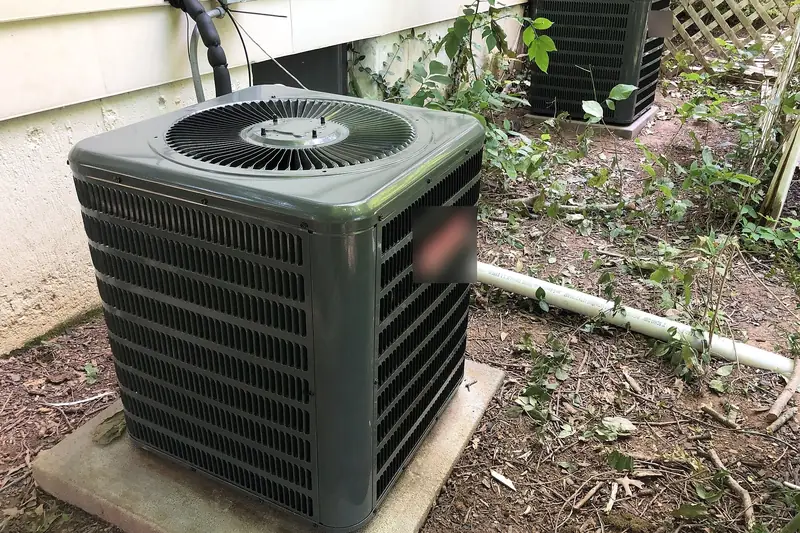
Go outside and listen: a running condenser has a spinning top fan and a steady hum from the compressor. Lennox explains that when the indoor unit runs but the outdoor unit has lost power, your system won't be able to complete the cooling process, which often results in warm air indoors.
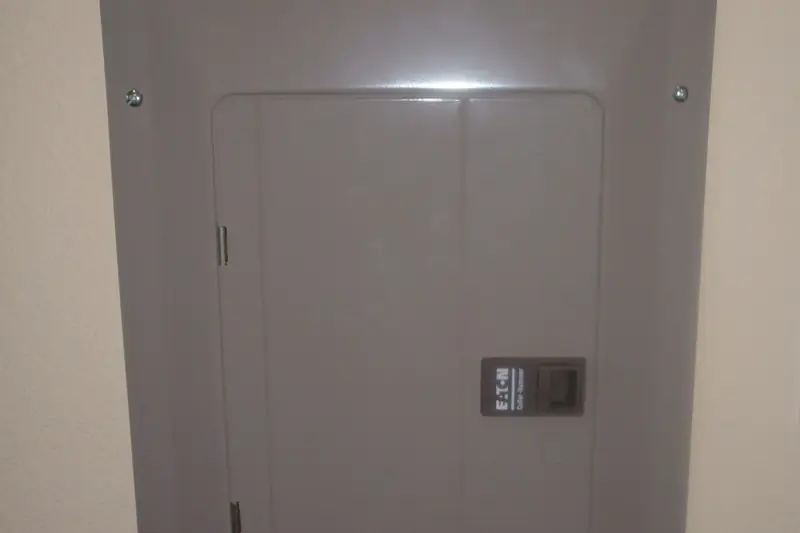
- Check the breaker panel for a tripped AC breaker and reset it once. If it trips again, leave it off and call.
- Check the disconnect near the outdoor unit is switched ON, and the indoor unit's switch, which often looks like a light switch.
- With power off at the disconnect, clear leaves, cuttings and debris; Trane suggests keeping plants at least 2 feet from the sides.
If the outdoor fan hums but won't spin, turn the system off at the thermostat and don't poke at the fan. Carrier warns that capacitors hold a high-voltage charge even when power is off, so capacitor and contactor work belongs to a licensed technician. The AC not turning on and AC unit buzzing pages cover that symptom in more depth.
Stop and call if
- The breaker trips again after one reset.
- The outdoor fan hums but doesn't spin, or you smell burning plastic at either unit.
- Ice comes back within a day of a full thaw.
- You hear loud buzzing, hissing or banging, which Lennox lists among its call-a-technician signs.
- Water is pooling near the furnace, air handler or any electrical part.
- If you're unsure, stop and call a licensed HVAC technician.
Could a frozen coil cause the warm air?
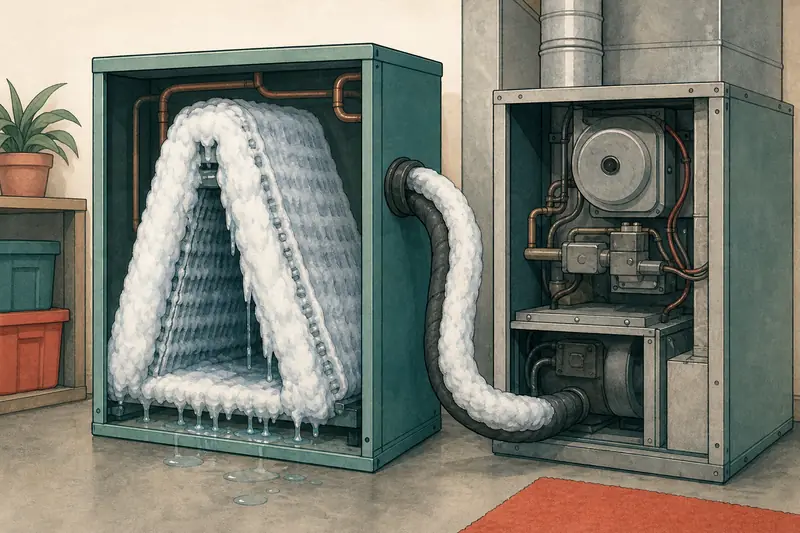
Yes: a coil that has iced over can't absorb heat, so the blower moves warm air past it. Carrier explains ice forms when warm air isn't reaching it (airflow restriction) or the pressure inside the coil is too low, and Trane adds that a dirty filter or blocked return can do it. Look for frost on the copper line at the indoor unit or water around the cabinet.
To thaw it, switch the thermostat from COOL to OFF; Bryant and Trane say running the fan on ON speeds the thaw. Thawing usually takes a few hours, and heavy ice can take most of a day. Don't chip at the ice, don't aim a heater or hair dryer at it, and don't restart cooling until all of it is gone. The full routine is on the frozen AC coil page.
Is low refrigerant making the AC blow warm air?
It might be, but low refrigerant is a symptom of a leak, and that is a technician's job from start to finish. Lennox puts it plainly: low refrigerant is not something you can refill like windshield washer fluid, and a licensed technician must find and repair the leak first. The EPA's sales rule says only Section 608 certified technicians can purchase refrigerants for home air conditioners and heat pumps.
Signs that point that way: the system runs continuously without reaching the setpoint, ice keeps returning after a clean filter and a full thaw, or there is visible ice on the outdoor unit or refrigerant lines, both on Lennox's list of reasons to call. Write those down for the technician; don't open any line or cap.
Should you turn the AC off while it blows warm air?
Yes. Carrier recommends turning off the AC immediately if it is blowing warm air, because running a malfunctioning system can overheat the compressor. Leave the fan on AUTO, or on ON only if you're thawing a frozen coil.
Tell the technician
When it started
The day and time, the outdoor temperature, and whether it cooled at all earlier that day.
What the outdoor unit does
Silent, humming without the fan spinning, or running with the fan turning.
What you saw
Ice on the lines, water at the indoor unit, a tripped breaker, or a burning smell.
What you already checked
Mode, fan setting, filter date, breaker reset once, disconnect position.
Readings
- 3most common causes to check first: breaker, thermostat, filterCarrier
- 1breaker reset before you call, if it trips againLennox
- 2 ftclearance from plants around the outdoor unitTrane
- 608EPA section limiting refrigerant sales to certified techniciansEPA
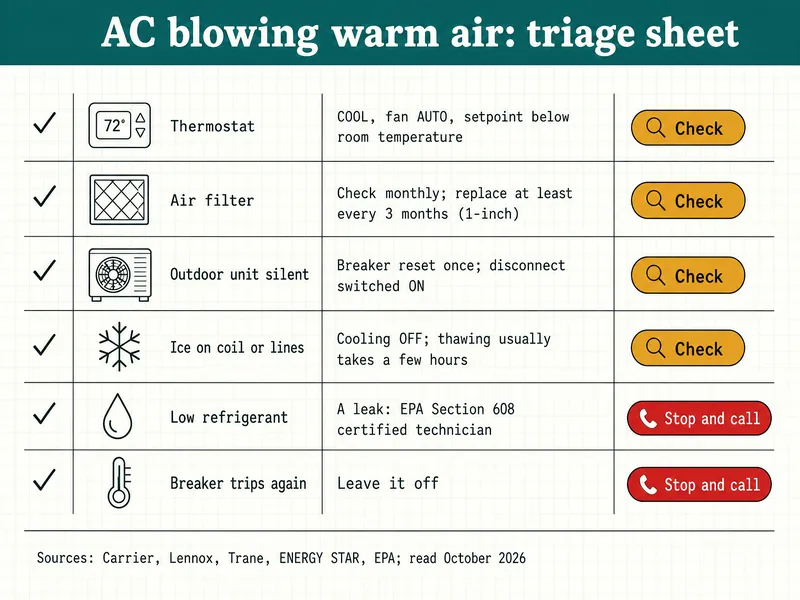
| What you notice | Likely cause | Safe check | Stop and call if |
|---|---|---|---|
| Warm air between cycles | Fan set to ON | Set the fan to AUTO | It stays warm while cooling runs |
| Indoor fan runs, outdoor unit silent | Tripped breaker or disconnect off | Reset the breaker once; disconnect ON | The breaker trips again |
| Weak, warm airflow | Clogged filter | Replace the filter | Airflow stays weak with a new filter |
| Frost on the copper line | Frozen coil | Cooling OFF, thaw for a few hours | Ice returns within a day |
| Runs nonstop, never reaches setpoint | Refrigerant leak | None for homeowners | Always: a certified technician |
Case notes
Based on the AC troubleshooting pages of Carrier, Lennox, Trane and Bryant, the ENERGY STAR maintenance checklist and the EPA's Section 608 refrigerant sales page, all read in October 2026. Left out: Carrier's suggestion to brush the indoor coil (most coils are sealed in a cabinet), any heat source for thawing, every step inside the outdoor unit's service panel, and repair costs.
Asked at intake
Why does the AC run but never reach the setpoint?
Carrier lists a system that runs continuously without reaching the set temperature as a sign of low refrigerant, though a clogged filter or dirty coil can also make it run longer. Replace the filter first. If it still runs nonstop, call a technician.
Why is only one room getting warm air?
If most rooms cool and one doesn't, the cause is more often airflow to that room than the AC itself. Check that the register is open and the return path isn't blocked, then see the uneven room temperatures page.
Can a dirty outdoor coil make the AC blow warm air?
It can reduce cooling, and ENERGY STAR notes dirty coils make the system run longer. You can clear debris around the unit and gently hose the outside of the coil with power off at the disconnect, as Trane suggests. Deep coil cleaning inside the cabinet is a technician's job.
Is it normal for a heat pump to blow cool air in winter?
During defrost, a heat pump can send cooler air for a few minutes, up to about 15, while steam rises from the outdoor unit. The heat pump defrost mode page explains what's normal.
How long should you wait after resetting the breaker?
Carrier's AC troubleshooting page describes a reset with the thermostat off and the breaker off for at least 30 minutes, so the system's circuit board can reset. Do this once. If the breaker trips again, leave it off and call.
Can you add refrigerant from a store kit?
No. EPA rules limit refrigerant for home air conditioners to Section 608 certified technicians, and makers say a leak has to be found and fixed before any recharge.
Related pages
Back to the six symptom folders