Furnace Leaking Water: Find the Source
Furnace leaking water? A 90%+ efficiency furnace makes its own condensate, the AC coil on top drips in summer, and a whole-house humidifier can leak, so the season and the vent pipe point to the source.
Checked against makers' and agencies' documents by Hum Drip Hiss · how pages are made · Updated
Vitals
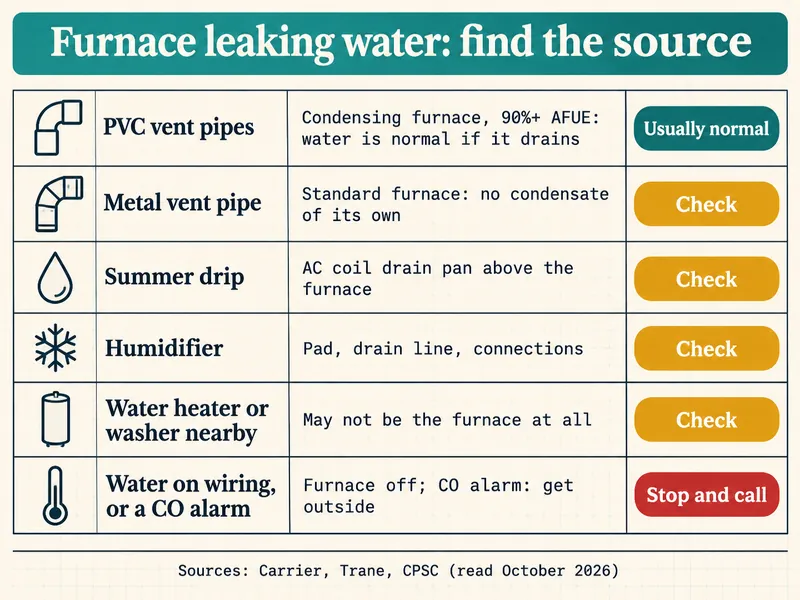
- Carrier says furnaces rated 90% AFUE or higher produce condensation by design; that water should run to a drain, not pool.
- Trane's quick test: two PVC pipes mean a condensing furnace; a metal exhaust pipe means a standard furnace that makes no condensate of its own.
- In summer, the usual source is the cooling coil sitting on the furnace and its drain pan, not the furnace itself.
- A whole-house humidifier can leak from a clogged pad, a cracked drain line or a loose connection (Trane).
- Carrier warns that a leak tied to the heat exchanger may carry a carbon monoxide risk, and says not to inspect it yourself.
- EPA: dry wet materials within 24 to 48 hours to prevent mold.
Why is the furnace leaking water?
Most furnace leaks come from one of four places: the furnace's own condensate drain, the AC coil and pan above it, a humidifier, or a condensate pump. Carrier lists a clogged condensate drain, a pump or drainage problem and a humidifier issue as the usual causes, with a heat exchanger problem less common but more serious.
Likely causes, most common first:
- A blocked condensate line or trap on a high-efficiency furnace (winter).
- The cooling coil's pan overflowing onto the furnace (summer).
- A humidifier with a scaled pad, a split drain tube or a dripping supply valve (winter).
- A condensate pump that has stopped.
- Not the furnace at all: Trane notes that a water heater, washing machine or wash tub in the same room can be the real source.
Which furnaces make water?
Condensing furnaces do; standard furnaces don't. Trane explains that a high-efficiency furnace has a secondary heat exchanger where water vapor in the exhaust turns to liquid, while a standard furnace has one heat exchanger and won't produce the same condensation. Carrier puts condensing models at roughly 90% to 98% AFUE.
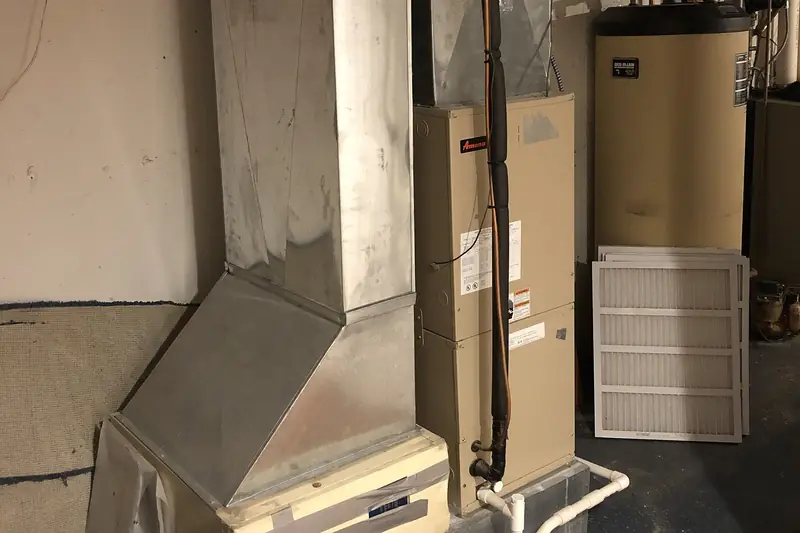
The pipes tell you which you have. Two white or gray PVC pipes leaving the furnace (exhaust and intake) mean a condensing model, so some water in its drain tubing is normal. A metal flue pipe means a standard furnace, so a puddle under it in winter points to something else: a humidifier, a pump, or a nearby appliance.
Is it the AC coil above the furnace?
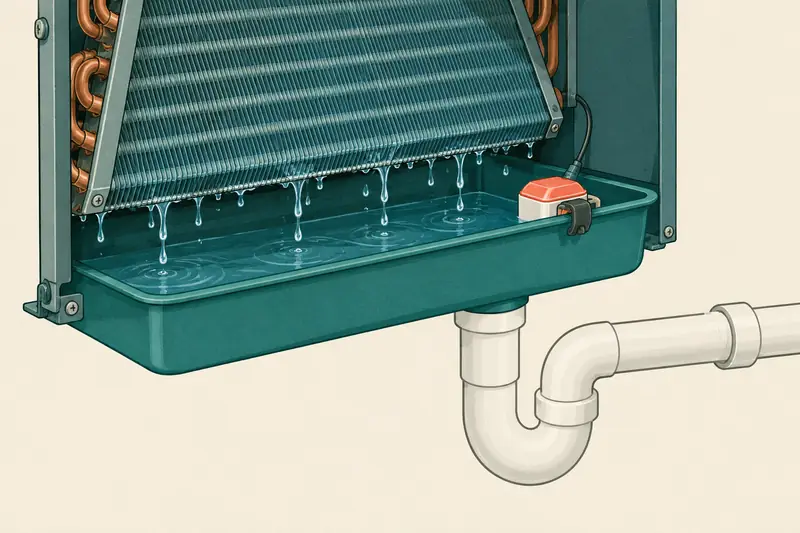
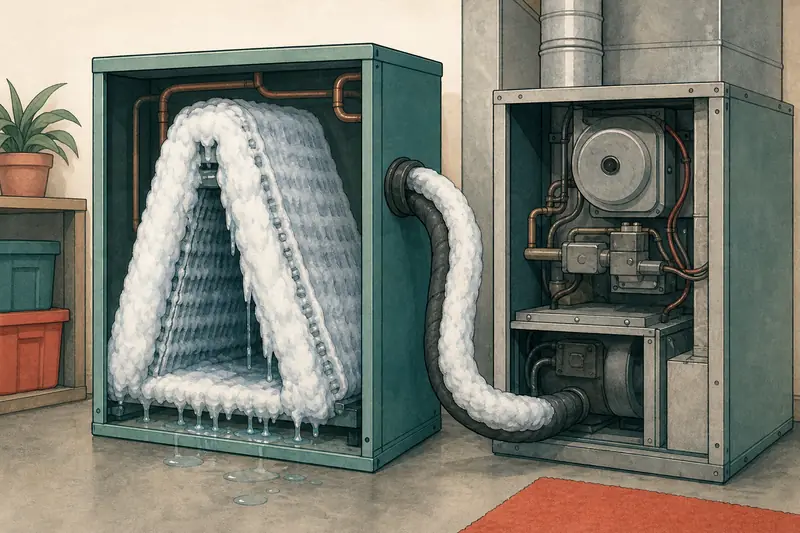
In cooling season, yes, most of the time. The coil cabinet sits on top of the furnace, and when its drain clogs, Trane says the pan can overflow and leave a puddle that looks like it came from the furnace. Water running down the outside of the furnace cabinet from the top is the giveaway.
The drain-line flush, the float switch and the condensate pump are covered step by step on AC leaking water inside. If you also see frost on the copper lines, read the page on a frozen AC coil before running cooling again.
Could the humidifier be leaking?
Yes, if the drip shows up in heating season near a box mounted on the duct beside the furnace. Trane names a clogged humidifier pad, a clogged or cracked drain line and loose connections as the usual faults, and Carrier lists a leaking humidifier, loose water connection or faulty pump among the water sources around a furnace.
Hard water plays a part. EPA's humidifier page says minerals in tap water may increase crusty deposits, or scale, and tells owners to follow the manufacturer's directions for central (furnace-mounted) units. A scaled pad passes less water through and sends more down the drain tube, which can split or clog. The humidifier maker's instructions decide what water it takes and how often the pad is changed; indoor humidity targets are on house humidity too high or too low.
What can you safely check?
Start outside the cabinet, with the furnace off at the thermostat and its switch, and only open what a homeowner is meant to open. Carrier's own table says to look for standing water but not to disassemble internal components.
- Set the thermostat to OFF and turn off the furnace switch (it looks like a light switch).
- Mop up and note exactly where the water collects: front, side, back, or under the coil cabinet.
- Check the season and the pipes: PVC pipes plus winter means the furnace's condensate; summer means the coil.
- Follow the visible drain tubing to the floor drain or pump and look for a kink, a disconnected end or a full pump tank.
- If the condensate line has a capped access point outside the cabinet, flush it with about a cup of distilled vinegar or the maker's approved cleaner. No chlorine products.
- Look at the humidifier from outside: a wet duct, a drip from its drain tube or a damp supply valve. Its saddle valve or water supply can be shut off where the maker's instructions show one.
- Replace a dirty filter; Trane lists the filter among causes of water on the floor.
The full order of homeowner checks lives on safe checks before you call. Leave the burner door in place, and don't touch the gas valve, igniter or heat exchanger.
When is a furnace leak urgent?
It is urgent when water reaches wiring or the control area, when a CO alarm sounds, or when a standard furnace drips with no humidifier, coil or appliance to explain it. Carrier says a cracked heat exchanger can let combustion gases, including carbon monoxide, into the airflow, and tells owners to turn off the furnace and call a qualified professional.
If a CO alarm goes off, or anyone has a headache, dizziness or nausea, get everyone outside to fresh air and call 911 or the fire department from outside, as CPSC advises. Don't go back in until responders say it's safe. The carbon monoxide detector beeping page explains alarm sounds, and the stop-and-call list covers the rest.
Stop and call if
- A carbon monoxide alarm sounds: get outside first, then call 911 from outside.
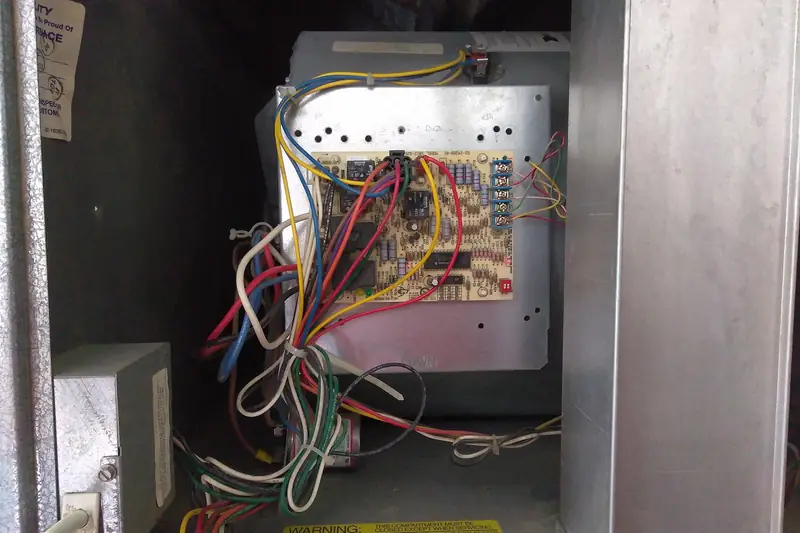
- Water is dripping onto the control board, wiring or the burner area.
- A standard (metal-flue) furnace leaks with no coil, humidifier or appliance nearby to explain it.
- You see rust streaks, soot or scorch marks on the furnace cabinet.
- The leak returns within days after the drain was cleared.
- If you're unsure, stop and call a licensed HVAC technician.
Tell the technician
Season and timing
Whether the water shows up while heating, while cooling, or both, and since when.
Furnace type
PVC vent pipes or a metal flue, and the model label if you can read it.
Where it pools
Under the coil cabinet, below the humidifier, at the pump, or under the burner side.
What you did
Filter changed, line flushed, humidifier water shut off, and what changed afterward.
What the sources say
- 90%+AFUE furnaces make condensate by designCarrier
- 2PVC pipes (exhaust and intake) mark a condensing furnaceTrane
- 24–48 hrsto dry wet materials before mold sets inEPA
- 1 cupdistilled vinegar for a condensate-line flushCarrier
| Source | When it leaks | Clue | Stop and call if |
|---|---|---|---|
| Condensing furnace drain | Heating season | PVC vent pipes; wet drain tubing | Line won't clear after one flush |
| AC coil drain pan | Cooling season | Water running down from the top | Water reaches wiring |
| Whole-house humidifier | Heating season | Wet duct or drip below the humidifier | Supply valve keeps dripping |
| Condensate pump | Either | Full tank, pump hums | Pump won't empty |
| Heat exchanger | Heating, rarely | Standard furnace, no other source | Always; a CO alarm means get outside |
The condensate pump card is a technician's part, shown so you know what it looks like and how it is specified. The softener cards are one option where a water test shows hard water scaling a humidifier; the humidifier maker's instructions still decide what water it should take.
Case notes
Sources: Carrier's furnace-leak and drain-line pages, Trane's furnace-leak page, EPA's mold and humidifier pages and CPSC's carbon monoxide page, read in October 2026. Left out: any step inside the burner compartment, heat exchanger checks, humidifier rewiring, chlorine-based cleaners and repair prices.
Asked at intake
Why does my furnace leak only when the AC is running?
The cooling coil sits on top of the furnace and makes water all summer. When its drain slows, the overflow runs down the furnace cabinet and looks like a furnace leak.
Is water in a high-efficiency furnace's drain tubing normal?
Yes. Condensing furnaces turn exhaust vapor into water on purpose, and that water travels through tubing to a drain or pump. It becomes a problem only when it ends up on the floor.
Can a furnace leak cause mold?
It can if materials stay wet. EPA's advice is to dry wet areas and items within 24 to 48 hours and to keep drain lines flowing.
Should I turn off a leaking furnace in winter?
Turn it off if water is near wiring or the control area, or if you can't tell where it's coming from. A small drip from a humidifier can often wait for a technician once its water supply is shut off.
Why is the humidifier leaking more this year?
Scale from hard water can clog the pad and drain tube over a season. EPA notes tap-water minerals increase scale in humidifiers; the maker's instructions say how often to replace the pad.
Can a cracked heat exchanger leak water?
Carrier lists a heat exchanger problem as a less common cause and warns it may pose a carbon monoxide risk. Only a technician should inspect it, and working CO alarms on every level matter more than any visual check.
My furnace has a metal flue and still drips. What else could it be?
Check the humidifier, the coil cabinet above, the pump, and any water heater or washer nearby. If none explains it, leave the furnace off and call.
Related leak pages
Back to all symptoms, by what you notice